What a Professional Tree Removal Crew Does Before the Chainsaw Starts
Most homeowners in Napa Valley and Sonoma County judge a tree removal crew the same way: the tree comes down, the debris gets cleaned up, the crew leaves. If those three things happen without visible incident, the job looks successful.
What is not visible is everything that happened before the chainsaw started. The site assessment that determined the fall zone. The escape routes established before the first cut. The rigging decisions that kept a 2,000-pound section of valley oak from landing on the fence line. The communication protocols between the climber in the canopy and the ground crew below. The inspection of every rope, carabiner, and harness before anyone left the ground.
Professional tree removal in Napa Valley and Sonoma CA is governed by the ANSI Z133 Safety Requirements for Arboricultural Operations, the national safety standard for the tree care industry developed under the American National Standards Institute and maintained by the International Society of Arboriculture. First established in 1971 and most recently revised in 2017, ANSI Z133 sets the minimum safety requirements that professional crews follow on every job. It is what separates a crew that has thought carefully about what can go wrong from one that has not.
This guide covers the seven safety protocols that define professional tree removal, what each one involves, and why the absence of any one of them on a job site in Sonoma County or Napa Valley is a signal worth paying attention to.
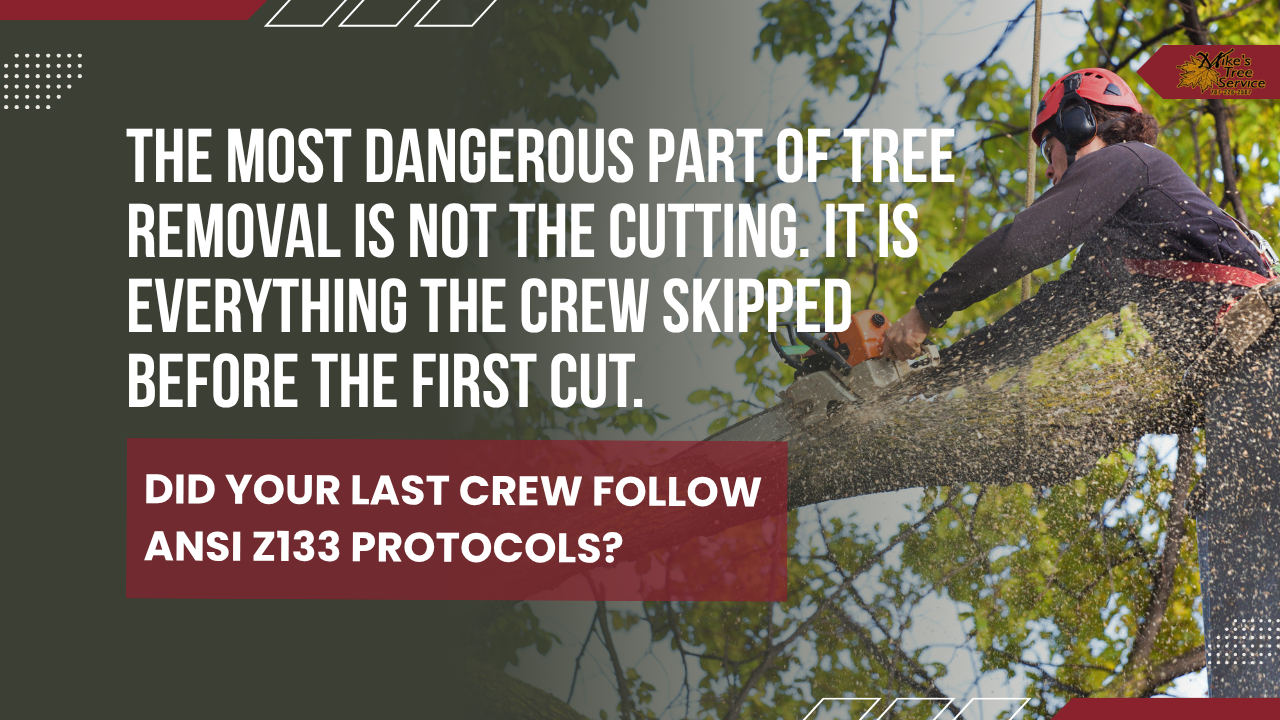
Why Tree Removal Safety Matters More Than It Appears
Tree work is consistently identified by OSHA as one of the most hazardous occupations in the United States. According to the Tree Care Industry Association, the two categories that account for the most fatal injuries in tree work are struck-by incidents from falling objects and falls from height. Both categories are addressable through proper protocol. Both categories continue to produce fatalities and serious injuries in tree work precisely because not every crew follows the protocols that prevent them.
For Napa Valley and Sonoma County property owners, the safety question is not abstract. A tree removal job that goes wrong on your property does not just injure a worker. It can damage your structure, the neighboring property, or a utility line. And if the crew working on your property does not carry workers compensation insurance, the injured worker's medical costs and lost wages can fall on you as the property owner.
The seven protocols below are what Mike's Tree Service follows on every job, from a single tree removal in Sonoma CA to a multi-tree land clearing project in the Carneros hills. They are also the questions worth asking any tree removal company near you before work begins.
Protocol 1: Pre-Job Hazard Assessment
Before any equipment is unloaded and before any crew member approaches the tree, a qualified professional conducts a formal hazard assessment of the job site. This is not a visual glance from the truck. It is a structured evaluation of every condition that could affect the safety of the operation.
According to ANSI Z133 2017, employers are required to communicate the following to all crew members before work begins: hazards associated with the job, work procedures involved, special precautions, electrical hazards, job assignments, and personal protective equipment requirements.
What the hazard assessment covers on a Napa Valley or Sonoma County job:
- Tree condition: Internal decay indicators, root plate stability, co-dominant stem defects, dead wood in the canopy, and any structural conditions that affect how the tree will behave when cut
- Site conditions: Overhead utility lines, underground utilities, proximity to structures, neighboring property boundaries, soil stability under equipment, and access limitations
- Environmental conditions: Wind speed and direction at the time of the job, recent rainfall that may have affected soil stability or root plate conditions, and visibility conditions that affect communication between crew members
- Fall zone identification: Every possible direction the tree or any section of it could fall, and what is in each potential fall zone
A crew that begins work without completing this assessment has skipped the step that all subsequent safety decisions depend on.
Protocol 2: Utility Identification and Clearance
California law requires that 811 be called before any digging, but utility awareness in tree removal extends beyond underground lines. Overhead electrical lines running through or near a tree's canopy are one of the most serious hazards in tree removal operations and one of the most commonly underestimated by property owners watching from the ground.
According to ANSI Z133 Section 4, which is dedicated entirely to electrical hazards, only qualified line-clearance arborists should perform tree work within specific proximity to energized conductors. The standard specifies minimum approach distances that apply to crew members based on the voltage of the line. Working outside these distances without appropriate qualifications and protective equipment is a violation of both ANSI Z133 and OSHA regulations.
What professional crews do regarding utilities:
- Identify all overhead lines in and around the work area before the assessment is complete
- Determine whether any lines run through the canopy or fall zone of the tree being removed
- Contact the utility provider to de-energize lines when work cannot be safely performed at the required approach distances
- Ensure that only qualified line-clearance arborists perform any work that requires closer proximity to energized conductors than the standard permits
In Sonoma County and Napa Valley, where older residential neighborhoods in Sonoma CA, Glen Ellen, and Kenwood often have overhead service lines running through mature tree canopies, this protocol is relevant on a significant portion of residential tree removal jobs.
Protocol 3: Personal Protective Equipment for Every Crew Member
ANSI Z133 specifies the personal protective equipment that must be worn by crew members during different phases of tree removal operations. This is not a recommendation. It is a requirement, and OSHA citations for tree care operations frequently reference ANSI Z133 PPE requirements when crew members are observed without required equipment.
Required PPE for ground crew during active cutting operations:
- Head protection: Hard hats meeting ANSI Z89.1 standards for falling object protection
- Eye and face protection: Safety glasses or face shields protecting against wood chips, sawdust, and debris from the cutting zone
- Hearing protection: During chainsaw operations, noise levels exceed OSHA's action level of 85 decibels, requiring hearing protection for sustained exposure
- Leg protection: Cut-resistant chaps or pants when operating a chainsaw, providing protection against chainsaw contact injuries
- Foot protection: Steel-toed boots with cut-resistant properties for ground crew in the cutting zone
- High-visibility clothing: For jobs near roadways or where crew members could be in the path of vehicles
Required PPE for climbers:
- Climbing harness: Rated and inspected for the load requirements specified in ANSI Z133, with anchor points capable of supporting the required safety factors
- Helmet with face shield and hearing protection: Integrated climbing helmets that combine head, face, and hearing protection are the current industry standard
- Cut-resistant gloves: Protecting hands during chainsaw operations aloft
A crew that arrives without complete PPE for every member has indicated something about how it approaches the protocols that are not visible.
Protocol 4: Drop Zone Control and Ground Crew Positioning
The ground below a tree being removed is one of the most dangerous places to be during a tree removal operation. Falling debris, dropped tools, and released rigging can reach the ground faster than a person can react. Professional crews establish and control the drop zone before any cutting begins and maintain that control throughout the operation.
According to ANSI Z133, a communication protocol must be established between arborists working aloft and personnel working on the ground. The standard specifies clear communication signals, including "stand clear" and "all clear," that govern when ground crew can enter and exit the drop zone.
What drop zone control looks like on a professional job:
- Physical demarcation of the hazard zone: Cones, flagging tape, or crew positioning that establishes a clear boundary that bystanders, pets, and non-essential crew members do not cross during cutting operations
- Ground crew positioning: At no point during active cutting operations should ground crew be directly beneath the work zone or within the identified fall radius of the section being cut
- Communication before every cut: The climber communicates clearly before releasing any section, and ground crew confirms their position is clear before the cut proceeds
- Bystander management: Property owners and any observers are positioned outside the established hazard zone for the duration of cutting operations
On residential properties in Sonoma CA, Napa, and the surrounding Wine Country communities, drop zone management is complicated by the proximity of structures, fences, neighboring properties, and the presence of the homeowner who wants to watch. Professional crews manage all of these factors as a standard part of every job.
Protocol 5: Rigging System Inspection and Load Calculation
When a tree cannot be felled in a single direction, when it is adjacent to a structure, or when sections need to be lowered in a controlled manner rather than dropped, rigging systems are used to control the descent of each section. A rigging system that fails during a lowering operation releases the full weight of the section being controlled, with potentially catastrophic consequences for anything in the path below.
ANSI Z133 requires that personal fall protection systems, including harnesses and anchorages, be capable of supporting at least 5,000 pounds per worker, and that anchor points be visually inspected and tested before climbing begins.
What a professional rigging inspection involves:
- Rope condition inspection: Every rope used for climbing or rigging is inspected for cuts, abrasion, chemical damage, heat damage, and excessive wear before use on each job. Ropes that show damage are removed from service.
- Hardware inspection: Carabiners, pulleys, friction devices, and rigging rings are inspected for cracks, deformation, gate function, and wear indicators that signal the component is approaching the end of its service life
- Anchor point assessment: The branch or stem used as a rigging anchor is assessed for strength and structural integrity before any load is applied. An anchor point in decayed wood is not a safe rigging anchor regardless of its diameter.
- Load estimation: The weight of the section being rigged is estimated before the cut, and the rigging system components are confirmed to be rated for the load with the appropriate safety factor applied
For Napa Valley and Sonoma County properties where mature valley oaks, coast live oaks, and large ornamental trees are common, large-section lowering is a routine part of residential tree removal. The rigging system that handles it safely is the result of pre-job inspection and load planning, not improvisation.
Protocol 6: Chainsaw Safety and Kickback Prevention
The chainsaw is the primary tool in tree removal operations and also one of the primary sources of serious injury. According to industry safety data, chainsaw kickback, which occurs when the upper portion of the guide bar contacts an object and the saw rotates rapidly back toward the operator, is responsible for a significant portion of chainsaw injuries in tree care operations.
ANSI Z133 addresses chainsaw safety requirements including the use of chain brakes, kickback-reducing chain and bar configurations, required personal protective equipment during chainsaw operation, and the positioning of the operator relative to the cut.
Chainsaw safety protocols that professional crews follow:
- Pre-use inspection: Every chainsaw is inspected before use for chain condition, chain tension, bar condition, chain brake function, and all safety features before it is started
- Two-hand grip: Chainsaws are operated with both hands on the handles at all times during cutting operations, never single-handed
- Kickback zone awareness: Operators are trained to position themselves out of the kickback arc and to be aware of the upper quadrant of the bar at all times
- Clear footing before cutting: The operator confirms stable footing before initiating any cut, particularly when working on slopes or irregular terrain common in Sonoma County's hillside properties
- No cutting above shoulder height with a chainsaw: A cut initiated above shoulder height places the operator in an unstable position and increases kickback risk substantially
- Chain brake engagement: The chain brake is engaged whenever the operator is moving between cuts or repositioning
Protocol 7: Post-Job Site Inspection and Cleanup
The job is not complete when the last section hits the ground. A professional crew conducts a post-job site inspection before leaving the property that confirms the work zone is safe and that no conditions created during the removal present an ongoing hazard.
What the post-job inspection covers:
- Stump condition: The stump is assessed for stability and any sharp or protruding edges that present a tripping or contact hazard are addressed
- Debris clearance: All wood sections, brush, and chip material are removed from the property or processed according to the agreed scope of work. Remaining wood debris on a Sonoma County or Napa Valley property during fire season is a specific concern given the region's documented wildfire risk.
- Damage assessment: Any incidental contact with structures, fencing, or landscaping during the operation is identified and communicated to the property owner before the crew departs
- Tool and equipment retrieval: Every tool, rope, rigging component, and equipment item is accounted for and removed from the property. A forgotten saw or rope in a tree is both a liability and a hazard.
- Final walkthrough with the property owner: A professional crew walks the completed work area with the property owner before departure, confirms the scope of work was completed as agreed, and answers any questions about the condition of the remaining trees or the property
What These Protocols Mean When You Are Choosing a Tree Removal Company Near You
The seven protocols above are not exceptional practices. They are the minimum standard for professional tree removal operations under ANSI Z133 and California's Cal/OSHA arboricultural safety requirements. A crew that follows all seven is operating at the professional standard. A crew that skips any of them has decided that standard does not apply to that job.
For Napa Valley and Sonoma County homeowners choosing a tree removal company near them, these protocols are observable during a professional estimate:
- Does the estimator conduct a thorough site assessment before proposing a scope of work?
- Does the crew arrive with complete PPE for every member?
- Do they establish a hazard zone and manage access to it before cutting begins?
- Can they explain their rigging approach for sections near your structure?
- Do they inspect equipment before use?
Mike's Tree Service serves Napa Valley and Sonoma County, including Sonoma CA, Kenwood, Glen Ellen, Yountville, St. Helena, Calistoga, and the surrounding Wine Country communities. The ISA-certified arborist team follows ANSI Z133 protocols on every job and provides free on-site assessments for any tree removal project, with honest guidance on the scope of work, the approach, and the cost before any work begins.