4 Tree Species in Napa Valley That Require the Most Frequent Trimming
Not every tree on a Napa Valley property needs the same amount of attention. Some mature oaks can go years between prunings and stay healthy and safe. Others grow fast, drop dead material constantly, or carry fire risk that makes regular trimming essential rather than optional. Knowing which trees fall into which category is one of the most useful things a property owner can understand, because it determines where trimming time and budget actually need to go.
That knowledge matters most right now. Early August is the heart of Napa Valley's wildfire season, and months of summer drought have left trees dry, stressed, and full of the dead material that carries fire. The species that need frequent trimming are exactly the ones that become the biggest liability this time of year if they have been left unattended.
Mike's Tree Service has cared for Napa Valley trees for over fifty years, across Napa, Sonoma, Kenwood, Glen Ellen, and Sonoma County. This guide covers the four species the team finds need trimming most often, and what proper maintenance looks like for each, with preservation of healthy trees always the goal.

1. Eucalyptus: Fast-Growing and High Fire Risk
Eucalyptus is at the top of the list for a reason. It grows fast, sheds constantly, and carries one of the highest fire risks of any tree in the Napa Valley landscape.
These non-native trees grow rapidly and continuously produce debris: bark strips, leaves, and branches that pile up beneath the canopy as a bed of highly flammable fuel. The oil content in eucalyptus leaves and bark is what makes the species so concerning in fire country. The Napa Communities Firewise Foundation lists eucalyptus among the notable high-flammability exceptions to the general rule that hardwoods burn poorly, and Napa County's defensible space guidelines name eucalyptus specifically among the plants to avoid leaving unmanaged in defensible space.
Why eucalyptus needs frequent attention:
- Rapid growth means canopies extend and overreach quickly
- Constant bark and leaf shedding builds fuel beneath the tree
- High oil content makes both the tree and its litter highly flammable
- Overextended limbs are prone to failure in wind
For eucalyptus on a Napa or Sonoma County property, regular trimming to manage the canopy, remove deadwood, and keep the debris cleared is not just maintenance. It is fire risk reduction, and it is why this species typically needs attention every year.
2. Coast Live Oak: The Evergreen Oak That Builds Ladder Fuels
Most native oaks in Napa Valley are relatively low fire risk, but the coast live oak is the exception, and it needs more frequent trimming than its deciduous cousins.
Unlike valley oaks and other deciduous oaks that drop their leaves and burn poorly, the coast live oak is evergreen and holds its foliage year-round. The Napa Communities Firewise Foundation notes that while most local oaks are low in flammability, the live oaks are the exception, and advises that they be kept in the landscape but pruned away from the ground with dead material removed to avoid ladder fuels. That guidance is the key: the coast live oak is worth preserving, but it needs regular structural pruning to stay safe.
What makes the coast live oak higher maintenance:
- Evergreen foliage holds more burnable material year-round
- Low, sweeping branches create ladder fuels to the ground
- Dead interior wood accumulates and needs removal
- Dense canopies benefit from thinning for airflow and safety
The preservation-first approach matters here. A coast live oak is a valuable, beautiful tree and a genuine asset to a Napa Valley property. The goal is never to remove it but to keep it properly pruned, limbed up off the ground, and clear of deadwood, so it remains both safe and healthy. Well-maintained live oaks can even shield a home by catching and deflecting embers.
3. California Bay Laurel: Aromatic, Dense, and Highly Flammable
The California bay laurel is a native tree many Napa Valley homeowners value for its aromatic leaves, but it is also one of the most flammable plants in the California landscape and needs regular management to keep it safe.
The oils that give bay laurel leaves their distinctive peppery scent are exactly what make the tree burn hot and fast. Fire professionals consistently rank it among the most flammable natives. The species also grows densely and can develop into thick, multi-stemmed stands that build up dead interior material and create continuous fuel. On top of the fire concern, bay laurel is the primary host that spreads the pathogen responsible for Sudden Oak Death, which makes managing it a health issue for the surrounding oaks as well.
Why bay laurel needs frequent trimming:
- High leaf oil content makes it burn hot and fast
- Dense, multi-stem growth builds interior deadwood
- Overgrown stands create continuous ladder fuels
- It hosts the pathogen that spreads Sudden Oak Death
Managing bay laurel means regular thinning, deadwood removal, and keeping it from forming the dense fuel-laden thickets it tends toward. On properties where it grows near valued oaks, that management protects the oaks as well as reducing fire risk.
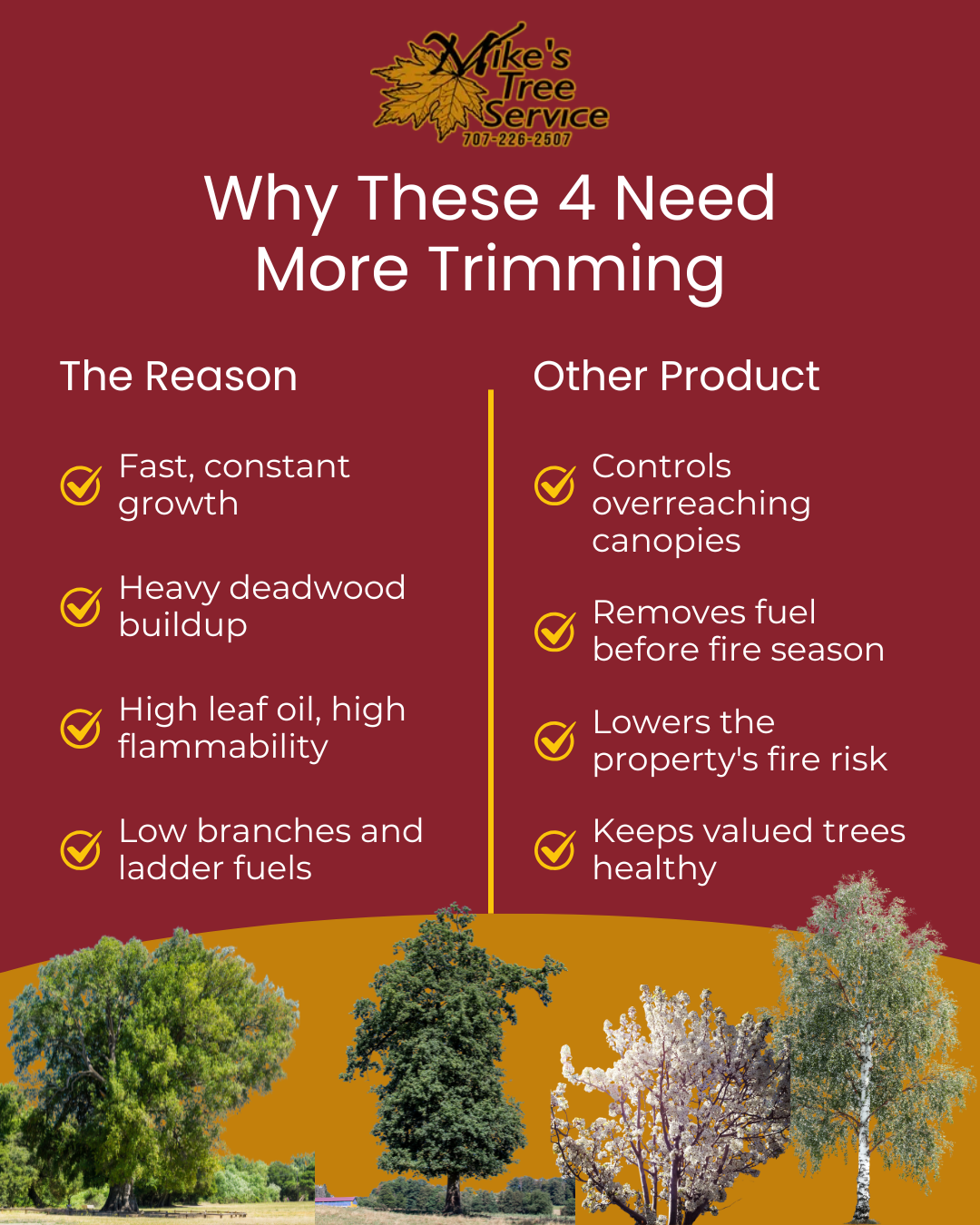
4. Fruitless Mulberry: Vigorous Growth That Demands Yearly Cuts
The fruitless mulberry is a popular shade tree on many Napa and Sonoma County properties, prized for its fast growth and dense summer canopy. That same vigor is exactly why it needs trimming more often than almost any other landscape tree.
Fruitless mulberries are typically pruned hard on an annual basis, a practice the tree tolerates well and even depends on to maintain its shape and structure. Left unpruned, they put on a large amount of rapid, weakly attached new growth each year, developing heavy, overextended limbs that are prone to breaking, especially as summer growth loads the canopy. Because the growth is so fast, skipping even a single year's pruning leaves the tree overgrown, structurally weaker, and harder to bring back into good form.
Why the fruitless mulberry is high maintenance:
- Extremely vigorous growth every single season
- Annual pruning is expected, not optional
- Skipped years produce weak, overextended limbs
- Heavy summer canopies strain the branch structure
Unlike the first three, the fruitless mulberry's demand for frequent trimming is about structure and vigor more than fire risk. But the outcome is the same: it is a species that rewards a regular schedule and punishes neglect, which is why it lands on the list of Napa Valley's most trimming-intensive trees.
How Often Each Species Actually Needs Trimming
Trimming frequency is not one-size-fits-all. These four species sit at the high-maintenance end, and understanding roughly how often each needs attention helps a property owner plan.
| Species | Typical trimming need | Primary reason |
|---|---|---|
| Eucalyptus | Yearly | Fast growth, high fire risk |
| Coast live oak | Every 1 to 2 years | Ladder fuels, evergreen foliage |
| California bay laurel | Yearly | Flammability, dense growth |
| Fruitless mulberry | Yearly | Vigorous growth, weak limbs |
These intervals are general starting points. The right schedule for any individual tree depends on its size, location, health, and proximity to structures, which is why an on-site evaluation matters more than a fixed calendar.
Why Timing Matters Heading Into Fire Season
For the three fire-risk species on this list, when the trimming happens is almost as important as whether it happens. The ideal window is before peak fire season, not during it.
| Season | Best trimming focus |
|---|---|
| Winter (dormant) | Major structural work, best for oaks |
| Early spring | Deadwood removal before fire season |
| Summer | Hazard and light maintenance only |
| Fall | Post-season cleanup, prep for winter work |
Right now, in the heart of the August fire season, the priority shifts to hazard reduction: clearing deadwood, removing obvious ladder fuels, and addressing any tree that poses an immediate risk near a structure. The Napa Communities Firewise Foundation and Napa County both emphasize that ongoing maintenance, not one-time work, is what keeps defensible space effective, since dead material accumulates every season. For the larger structural pruning these species need, the dormant winter window is ideal, which makes late summer a good time to plan that work for the months ahead.
Mike's Tree Service approaches every property from a preservation standpoint. The goal with all four of these species is to keep healthy trees in the landscape, properly maintained and safe, rather than removing them. The tree trimming and pruning service covers the structural work, deadwood removal, and canopy management these species need, and for trees showing signs of decline or disease, a tree health evaluation is the right starting point. The related article on
the role tree trimming plays in wildfire risk reduction covers the defensible space picture in more depth.
Frequently Asked Questions
How often should eucalyptus trees be trimmed in Napa Valley
Eucalyptus generally needs attention every year because of how fast it grows and how much flammable debris it sheds. Regular trimming manages the canopy, removes deadwood, and keeps the bark and leaf litter cleared from beneath the tree. Given the species' high fire risk and its listing among the plants to manage in Napa County's defensible space guidelines, annual maintenance is a fire-safety measure as much as a health one.
Are coast live oaks a fire risk on my property?
Coast live oaks carry more fire risk than deciduous oaks because they are evergreen and hold their foliage year-round, and their low branches can create ladder fuels. The Napa Communities Firewise Foundation recommends keeping them in the landscape but pruning them up off the ground and clearing dead material. Properly maintained, a coast live oak is a valuable tree that can actually help shield a home by catching embers, so the approach is careful pruning rather than removal.
Why is California bay laurel considered a problem tree?
Bay laurel is one of the most flammable plants in the California landscape because of the high oil content in its leaves, and it tends to grow into dense stands that accumulate deadwood. It is also the primary host that spreads the pathogen behind Sudden Oak Death, which threatens nearby oaks. Regular thinning and deadwood removal manage both the fire risk and the disease risk, especially where bay laurel grows near valued oak trees.
Does trimming a tree hard every year hurt it?
For some species, hard annual pruning is exactly what they need. The fruitless mulberry, for instance, tolerates and even depends on aggressive yearly pruning to maintain its structure. For other species, the amount of live growth removed in a single year should be limited to protect the tree's health. This is why species matters so much, and why an experienced evaluation of each individual tree produces better results than applying the same approach to everything.
Can I trim these trees myself, or do I need a professional?
Light maintenance like clearing fallen debris is something a homeowner can do. Structural pruning, deadwood removal from the canopy, ladder-fuel management, and any work on larger trees or near structures calls for a professional, both for safety and because improper cuts can damage the tree or worsen its structure. For the fire-risk species especially, proper technique is what makes the difference between reducing risk and creating new problems.
Does Mike's Tree Service work in Sonoma, Kenwood, and Glen Ellen as well as Napa?
Yes. Mike's Tree Service provides tree trimming, pruning, and tree health evaluations across Napa Valley and into Sonoma County, including Sonoma, Kenwood, and Glen Ellen. Every project begins with an on-site walkthrough to assess each tree individually and determine the right approach, with preservation of healthy trees as the priority.
If you have eucalyptus, coast live oak, California bay laurel, fruitless mulberry, or any trees that may need attention on your property in Napa, Sonoma, Kenwood, or Glen Ellen, Mike's Tree Service can evaluate them and recommend the right trimming approach, especially valuable heading into the heart of fire season. The goal is always to keep your healthy trees safe and thriving.