Stump Grinding vs Stump Removal Napa Valley: Which One Does Your Property Need
Introduction
After a tree comes down on a Napa Valley property, the stump question is almost always the next conversation. Most homeowners assume stump grinding and stump removal mean the same thing — they don't. They're two distinct processes with different costs, different outcomes, and different applications depending on what you plan to do with the space afterward. Getting this choice wrong means either paying for more than you need or paying twice because the first method didn't accomplish what you actually needed. Mike's Tree Service provides stump grinding and stump removal throughout Napa Valley — and this guide explains exactly what each process involves, what it costs in this specific market, and how to know which one your property actually needs.
What Is Stump Grinding — And What Does It Actually Do?
Stump grinding is the most common post-removal service in Napa Valley — and the right choice for the majority of residential applications:
The process:
A stump grinder is a specialized machine with a rotating cutting wheel that chips the stump down to a specified depth below the existing grade. The standard grinding depth for residential applications is 6 to 12 inches below the surface — enough to allow lawn regrowth, landscaping, or paving over the area.
What stump grinding does:
- Eliminates the visible stump above grade
- Produces wood chip material that fills the void left by the stump
- Allows the area to be replanted with grass, ground cover, or ornamental plantings
- Makes the area safe to walk on and mow over
- Eliminates the trip hazard and aesthetic issue the stump creates
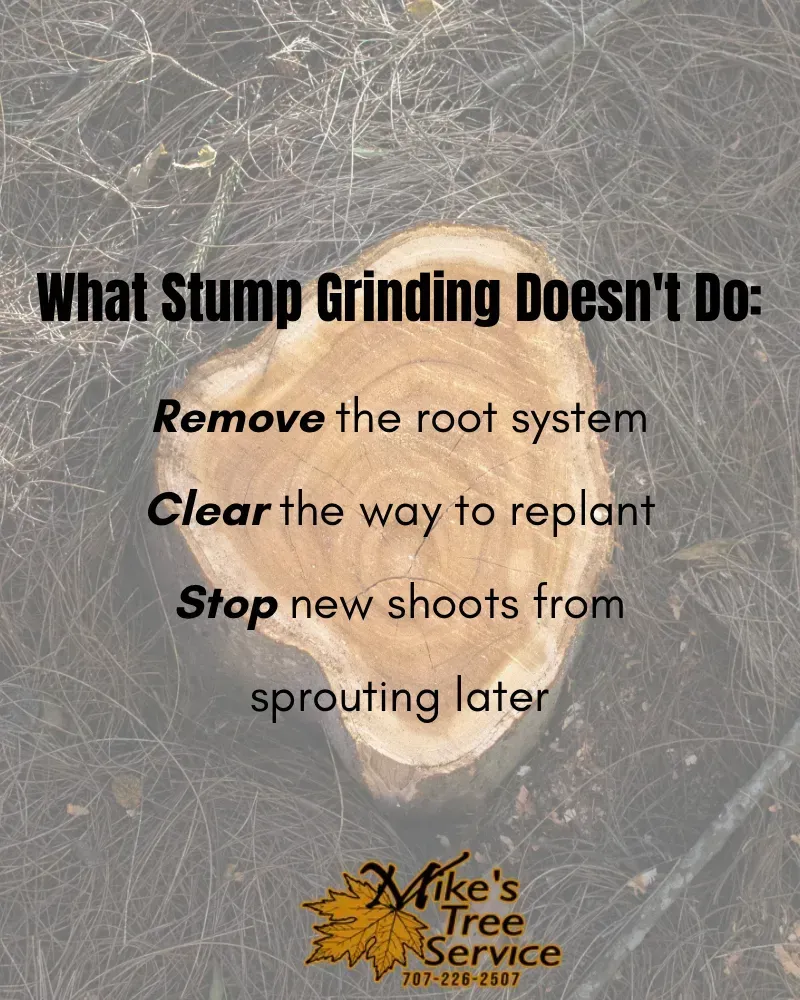
What stump grinding does not do:
- Remove the root system — roots remain in the ground and decompose naturally over 5 to 10 years
- Prepare the site for construction, hardscaping, or deep-rooted planting
- Eliminate every species' ability to resprout — some species send up new growth from remaining roots
The root decomposition reality:
After grinding, the remaining root system decomposes gradually below grade. During decomposition, the soil above may settle slightly as organic material breaks down — creating minor surface depressions that need to be topped up over the first 1 to 2 years. For lawn areas and ornamental planting, this is manageable. For paving, construction, or structural landscaping — it's a problem.
Napa Valley specific consideration — volcanic and clay soils:
Napa Valley's soil variability affects stump grinding outcomes. In rocky volcanic hillside soils, stump grinders encounter resistance from embedded rock that can limit achievable grinding depth. In heavy clay valley floor soils, the wood chip fill from grinding doesn't drain well — creating moisture retention conditions that homeowners should account for when planning surface restoration.
What Is Stump Removal — And When Is It Actually Necessary?
Full stump removal — also called stump extraction — goes beyond grinding to remove the entire stump and root ball from the ground:
The process:
Stump extraction uses excavation equipment to dig around and beneath the stump, sever the root structure, and physically remove the entire root ball from the ground. The result is a clean excavated void that can be backfilled with appropriate material.
What stump removal does:
- Eliminates the stump and the primary root ball entirely
- Produces a clean, stable excavated area with no organic material left to decompose
- Allows immediate construction, hardscaping, or structural landscaping in the footprint
- Eliminates all risk of soil settling from organic decomposition
- Required for any application where the root system's presence is problematic
What stump removal does not do:
- Remove every lateral root extension — major roots extending far from the stump may remain depending on excavation scope
- Eliminate all resprouting risk from lateral root sections
- Leave the area immediately ready for planting — soil amendment and preparation are required before replanting
When full removal is necessary:
- New construction or major renovation in the stump footprint
- Paving, concrete, or structural hardscaping directly over the area
- Irrigation system installation in the root zone
- Septic system work in proximity to the root ball
- Replanting in the immediate footprint where decomposing organic material would interfere with the new tree's establishment
- Species known to aggressively resprout from root sections — such as some California native species in Napa Valley
Stump Grinding vs. Stump Removal — The Side-by-Side Comparison
| Factor | Stump Grinding | Full Stump Removal |
|---|---|---|
| Process | Mechanical grinding to 6–12 inches below grade | Excavation and extraction of entire stump and root ball |
| Root system | Remains — decomposes over 5–10 years | Removed — clean excavation |
| Cost | Lower — $100 to $450 for most residential stumps | Higher — $300 to $1,000+ depending on root ball size |
| Site ready for lawn/planting | Yes — after wood chip removal and topsoil addition | Yes — after backfill and soil preparation |
| Site ready for paving/construction | No — organic decomposition creates settling risk | Yes — stable excavated area |
| Site ready for immediate replanting | Nearby only — not in the stump footprint | Yes — with soil preparation |
| Soil disturbance | Minimal | Significant — excavation required |
| Timeline | Hours | Half day to full day depending on root system |
| Right for Napa Valley | Lawn, ornamental planting, vineyard border aesthetics | Construction, hardscaping, irrigation, same-footprint replanting |
How Much Does Stump Grinding Cost in Napa CA?
Napa Valley stump grinding costs are influenced by stump diameter, wood species hardness, access, and soil conditions:
Size-based cost ranges:
| Stump Diameter | Typical Grinding Cost |
|---|---|
| Under 12 inches | $100–$200 |
| 12 to 24 inches | $150–$300 |
| 24 to 36 inches | $250–$400 |
| 36+ inches | $350–$600+ |
Factors that increase Napa Valley stump grinding cost:
- Rock and volcanic soil — grinding encounters resistance that slows the process and increases equipment wear, particularly on hillside Napa Valley properties
- Hardwood species — Oak, Walnut, and Bay Laurel are significantly harder than ornamental species and require more time and cutting wheel passes
- Root flare diameter — the effective grinding area includes the root flare, which can be significantly wider than the visible trunk diameter on mature oaks
- Access limitations — equipment access through gates, over slopes, or in tight spaces adds time and cost
- Multiple stumps — most services provide a per-stump discount when multiple stumps are ground in the same visit
Full stump removal cost ranges:
Full extraction costs more than grinding due to excavation equipment requirements and longer site time. Typical Napa Valley full removal ranges from $300 to $1,000+ depending on root ball size, soil type, and access.
The Napa Valley Species Guide — Grinding vs. Removal by Tree Type
Species affects both the grinding difficulty and the decision between grinding and removal:
Valley Oak and Coast Live Oak
Native oaks have extensive, wide root systems that can extend significantly beyond the canopy drip line. Grinding a mature Valley Oak stump addresses the visible surface problem but leaves a substantial root system that decomposes slowly over many years. For oak stumps near structures, irrigation systems, or new construction — full removal assessment is warranted. Note: any work on Valley Oak stumps should consider SOD protocol if Sudden Oak Death has been confirmed or suspected in the surrounding tree population.
California Bay Laurel
Bay Laurel is an aggressive resprouter — cut stumps and ground stumps frequently produce new growth from remaining root sections. If Bay Laurel is being removed as part of an SOD management program around susceptible oaks, complete root removal rather than grinding is recommended to reduce resprouting and continued root zone presence near oak root systems.
Olive
Olive stumps grind relatively easily but are among the most aggressive resprouters of any species in Napa Valley. Grinding without herbicide treatment of the remaining root system frequently produces vigorous new growth from root sections. For Olive stumps where resprouting is unacceptable — chemical treatment of cut roots at the time of removal is the standard protocol.
Italian Cypress
Cypress stumps grind cleanly and the root system does not aggressively resprout. Grinding is the appropriate choice for most Cypress stump situations.
Fruit trees and ornamentals
Most orchard and ornamental species grind cleanly without significant resprouting concerns. Full removal is indicated only when the footprint is being replanted or developed.
What Happens to the Wood Chips After Grinding?
This is a question most Napa Valley homeowners don't ask until after the grinding is complete:
Option 1 — Leave the chips as fill
The wood chip material produced by grinding fills the void left by the stump. It can be left in place, lightly mounded above grade, and allowed to decompose. This is the lowest-cost option and works for areas that aren't being immediately replanted.
Option 2 — Remove the chips and backfill with topsoil
For areas being replanted with lawn or ornamental plants — the wood chip fill should be removed and replaced with topsoil and compost. Wood chip fill is high-carbon organic material that depletes nitrogen as it decomposes, creating poor growing conditions for new plantings. On Napa Valley's clay soils, replacing chip fill with amended topsoil produces significantly better planting outcomes.
Option 3 — Repurpose as mulch
Wood chip material from stump grinding makes excellent mulch for the broader landscape — applied at the drip line of other trees and shrubs rather than in the stump void. Mike's Tree Service can spread chip material across the property rather than removing it if this is the preferred outcome.
Mike's Tree Service: Stump Grinding and Removal Throughout Napa Valley
The stump question always follows the tree removal conversation — and the right answer depends on your specific property, the species involved, and what you're planning to do with the space. Mike's Tree Service provides ISA certified stump assessment, stump grinding, and full stump removal throughout Napa, Yountville, St. Helena, Calistoga, Sonoma, Kenwood, and surrounding Napa and Sonoma County wine country.
What every Mike's Tree Service stump service includes:
| Service Component | What It Covers |
|---|---|
| Site assessment before recommendation | Grinding vs. removal recommendation based on your specific species, soil, and plans |
| Species-specific guidance | Resprouting risk, SOD protocol considerations, root system extent by species |
| Appropriate depth grinding | Standard 6–12 inch depth for most applications — deeper available for specific needs |
| Wood chip management options | Leave as fill, remove and replace with topsoil, or spread as landscape mulch |
| Full root ball extraction | Excavation and removal for construction, hardscaping, and same-footprint replanting applications |
| Soil restoration guidance | Post-removal backfill and amendment recommendations for Napa Valley's specific soil profiles |
| Combined with tree removal | Stump grinding added to any Mike's tree removal project |
| Multiple stump discount | Per-stump pricing reduction when multiple stumps are addressed in one visit |
Contact Mike's Tree Service today to schedule your Napa Valley stump assessment.
Schedule Your Stump Assessment →
Read: Tree Removal in Napa Valley →
Read: Sudden Oak Death in Napa Valley →
Read: How to Choose the Right Tree for Your Napa Valley Property →