How a Single Tree Removal Decision Can Shift the Value of a Napa CA Property
A single mature tree can change the feel of an entire Napa Valley property. It can shade a west-facing wall, frame a vineyard view, screen a neighboring parcel, soften a driveway, or make an estate landscape feel established in a way newer planting cannot reproduce quickly. The same tree can also become a liability if it is structurally unstable, declining, interfering with utilities, damaging hardscape, or creating a level of risk that pruning cannot reasonably correct. That is why tree removal in Napa, CA is not simply a maintenance decision. It is a property decision, and the real question is whether removing the tree improves the property enough to justify what the property loses.
Research from the U.S. Forest Service supports the broader value of healthy tree cover. A 2022 national meta-analysis of U.S. tree-cover studies found a generally positive relationship between tree canopy and home values, while a 2025 Forest Service study also found measurable homeowner value associated with tree cover. The important distinction is simple: a healthy, well-placed mature tree and a declining tree over a structure are not the same asset.
What a Mature Tree Is Actually Contributing to a Napa Property
Before removal makes sense, it helps to understand what the tree is doing for the property today.
Shade and heat protection.
In August, a mature canopy may be reducing direct afternoon sun on patios, walls, driveways, and outdoor living areas. Removing that tree can make the space noticeably hotter immediately.
Privacy and screening.
Trees often block views of roads, neighboring homes, utility areas, or service spaces. That value can be easy to overlook until the screening disappears.
View framing.
A tree can either block a vineyard or hillside view or make that view feel more intentional by framing it. The placement matters as much as the size.
Landscape maturity.
A 30- or 40-year-old tree gives a property scale and character that a young replacement tree cannot restore quickly.
Wind and exposure.
On larger Napa Valley parcels, established trees can also help soften exposed areas and create more usable outdoor spaces.
What One Tree May Be Adding to the Property
| Tree Contribution | Why It Matters |
|---|---|
| Shade | Reduces heat exposure around the home and outdoor areas |
| Privacy | Screens roads, neighbors, and service areas |
| Curb appeal | Makes the property feel established |
| View framing | Can improve vineyard, hillside, or valley views |
| Wind buffering | Helps soften exposed areas |
| Landscape character | Adds maturity that takes decades to replace |
| Risk reduction when removed | A hazardous tree may improve safety and maintenance confidence |
The property-value question starts when the benefits of keeping the tree begin to compete with the risks or costs of retaining it.
When Removing a Tree Can Protect Property Value
There are situations where removal is not a loss. It is a way to prevent a larger property problem.
Structural failure risk.
A tree leaning toward a home, guest house, winery structure, driveway, or utility line may still provide shade and character. If the root plate is failing or a major union is splitting, those benefits may no longer outweigh the risk.
Severe decline.
A tree with advanced decay, large dead sections of canopy, or irreversible disease can continue losing structural value while becoming more expensive and more difficult to remove later.
Repeated limb failure.
One broken limb does not automatically mean the tree should come down. Repeated failures from major scaffold branches are different because they may indicate that the remaining structure is becoming unreliable.
Property conflict that cannot be corrected.
Roots affecting critical hardscape, utility conflicts, or a tree positioned too close to a structure may eventually reach a point where pruning no longer solves the problem.
Conditions That Commonly Push the Decision Toward Removal
- Significant trunk or structural decay
- Major root failure
- Dead or rapidly declining canopy
- Severe storm damage
- Irreversible disease
- Repeated large limb failures
- Unmanageable conflicts with foundations or utilities
- A tree that cannot be retained safely near a structure
Mike's Tree Service explains the process in more detail in Tree Removal in Napa Valley: What to Expect, What It Costs, and How to Choose the Right Service.
The practical point is that a hazardous tree can create a much larger financial loss than the landscape value it still provides.
When Removing a Tree Can Reduce Property Value
Healthy mature trees are different. Removing one can immediately change shade, privacy, landscape balance, and visual maturity, especially when the tree has shaped the property for decades.
Common losses after removal:
- Shade loss: A patio or west-facing wall may receive significantly more August sun.
- Privacy loss: Roads, neighboring homes, or service areas may become more visible.
- Loss of maturity: A young replacement tree cannot recreate the scale of a mature canopy quickly.
- View changes: Removal may improve a vineyard view or expose utility lines, neighboring buildings, or traffic.
The U.S. Forest Service has summarized research showing measurable property and energy benefits tied to mature tree cover. A Forest Service review of shade and street tree benefits found positive impacts in other U.S. residential markets. That research should not be used to assign a fixed dollar amount to one Napa tree, but it supports a practical rule:
a healthy, well-placed mature tree should solve a real property problem before removal is considered worth the loss.
The August Problem: Drought Stress Can Look Like Decline
Late summer is one of the easiest times to misread a tree in Napa Valley.
By August, trees have gone through months of dry weather and high temperatures. Some respond with leaf scorch, early leaf drop, reduced growth, or a thinner canopy. Those symptoms can look serious without automatically meaning the tree is dying.
Seasonal stress may show up as:
- Browning leaf edges
- Early leaf drop
- Reduced new growth
- Sparse foliage
- Temporary canopy thinning
Progressive or structural decline may show up as:
- Large dead sections of canopy
- Major branch dieback
- Decay at the trunk or major unions
- Root plate movement
- Cracks or splits in structural wood
- Decline that continues across multiple seasons
A useful evaluation should also consider species, age, irrigation history, soil conditions, root-zone disturbance, disease signs, and previous pruning.
This is especially important with mature oaks. Mike's Tree Service's guide to oak tree care in Napa Valley explains why native oaks need a different approach around summer watering, pruning, and root-zone disturbance.
The August takeaway is simple: a stressed-looking tree may need monitoring or better care. A structurally failing tree may need removal. Those are very different recommendations.
Monitor, Prune, or Remove?
The best tree decision is not built around finding a reason to remove the tree. It is built around finding the most practical long-term outcome for the property.
Monitor when the condition may be temporary. Heat stress, drought response, or a mild canopy change may justify observation when the tree remains structurally sound.
Prune when the tree is healthy but the canopy is creating a manageable conflict. Deadwood removal, clearance pruning, weight reduction, or selective structural work may solve the problem without sacrificing the entire tree.
Remove when the tree no longer has a reliable path to safe retention. Severe structural failure, irreversible decline, repeated large failures, or unmanageable property conflicts can make removal the practical choice.
Property-Value Decision Guide
| Tree Condition | Best Question to Ask | Likely Direction |
|---|---|---|
| Healthy and well placed | What value is this tree already providing? | Preserve and maintain |
| Healthy but overgrown | Can pruning solve the conflict? | Prune |
| Heat or drought stressed | Is the decline reversible? | Monitor |
| Partially damaged | Can structure be restored safely? | Prune or monitor |
| Diseased but stable | Can decline be managed without creating risk? | Evaluate individually |
| Repeated large failures | Is the remaining structure reliable? | Removal may be practical |
| Dead, unstable, or root-failed | What is the risk of keeping it? | Removal is often appropriate |
The key difference is reversibility. Pruning can be adjusted. Monitoring can continue. A mature tree that has been removed cannot be put back.
How One Removal Can Change Views, Privacy, and Outdoor Use
One tree can influence how a property functions, not just how it looks.
A removal may improve the property when:
- It opens an important vineyard or hillside view
- It clears access around a driveway or structure
- It removes a failing tree near a high-use area
- It eliminates an unmanageable maintenance problem
- It creates space for a better long-term planting plan
A removal may reduce the property's usefulness when:
- A patio loses afternoon shade
- A neighboring property becomes more visible
- A road or utility area is exposed
- A building receives more direct summer sun
- The landscape loses balance or scale
A west-side shade tree is a good example. In August, that canopy may make an outdoor seating area usable in the afternoon. Removing it may solve a structural or root problem, but the property immediately gains more heat exposure.
A good removal plan considers the space that remains, not only the tree that leaves.
Wildfire Risk Can Change the Decision
August also brings wildfire concerns into the conversation. A tree near a structure does not automatically need removal for fire safety, because pruning, deadwood removal, clearance, and fuel separation may solve the problem while preserving a healthy tree. Mike's Tree Service explains that distinction in The Role Tree Trimming Plays in Wildfire Risk Reduction Across Napa Valley Properties.
Removal makes more sense when:
- The tree is dead
- The canopy is heavily declining
- Large deadwood cannot be managed reasonably
- Structural instability creates an additional hazard
- The fire-related conflict cannot be corrected through pruning
The goal is not maximum removal. The goal is a safer and more functional property.
Permit Requirements Can Change the Economics
Property owners in Napa Valley and Sonoma County also need to consider whether the tree is protected. Permit requirements vary by jurisdiction, species, size, zoning, and site conditions, so a tree that makes sense to remove physically may still require documentation or approval.
This is especially relevant for tree removal in Sonoma County, CA, including Kenwood and Glen Ellen. Sonoma County updated its tree protection rules in 2024, and some protected native trees may require permits or mitigation depending on the property. Mike's Tree Service explains those requirements in Why Napa Valley and Sonoma County Are Stricter Than Ever About Tree Removal Permits.
What Permit Requirements Can Affect
- Project timing
- Removal cost
- Replacement requirements
- Mitigation requirements
- Future development plans
- Property compliance
Skipping this step can create a different kind of property-value problem through fines, delays, or future development complications..
What Happens After the Tree Comes Down Matters Too
The property decision does not end when the tree is removed.
The stump.
A visible stump in a high-value landscape can make a finished removal look incomplete and limit how the space is used.
The root zone.
Settling, exposed irrigation, or uneven grade can affect the next phase of the landscape.
The replacement plan.
If the removed tree provided important shade, privacy, or visual framing, the property may need a replacement strategy rather than an empty space.
The final landscape.
A removal should make the property feel safer and more intentional, not unfinished.
Mike's Tree Service explains why stump management matters in 6 Reasons Why Napa CA Homeowners Should Grind Down Tree Stumps in Their Yard.
If replacement planting is part of the plan, the guide to choosing the right tree for a Napa Valley property explains why drought tolerance, mature size, root behavior, and placement should be considered before the next tree goes into the ground.
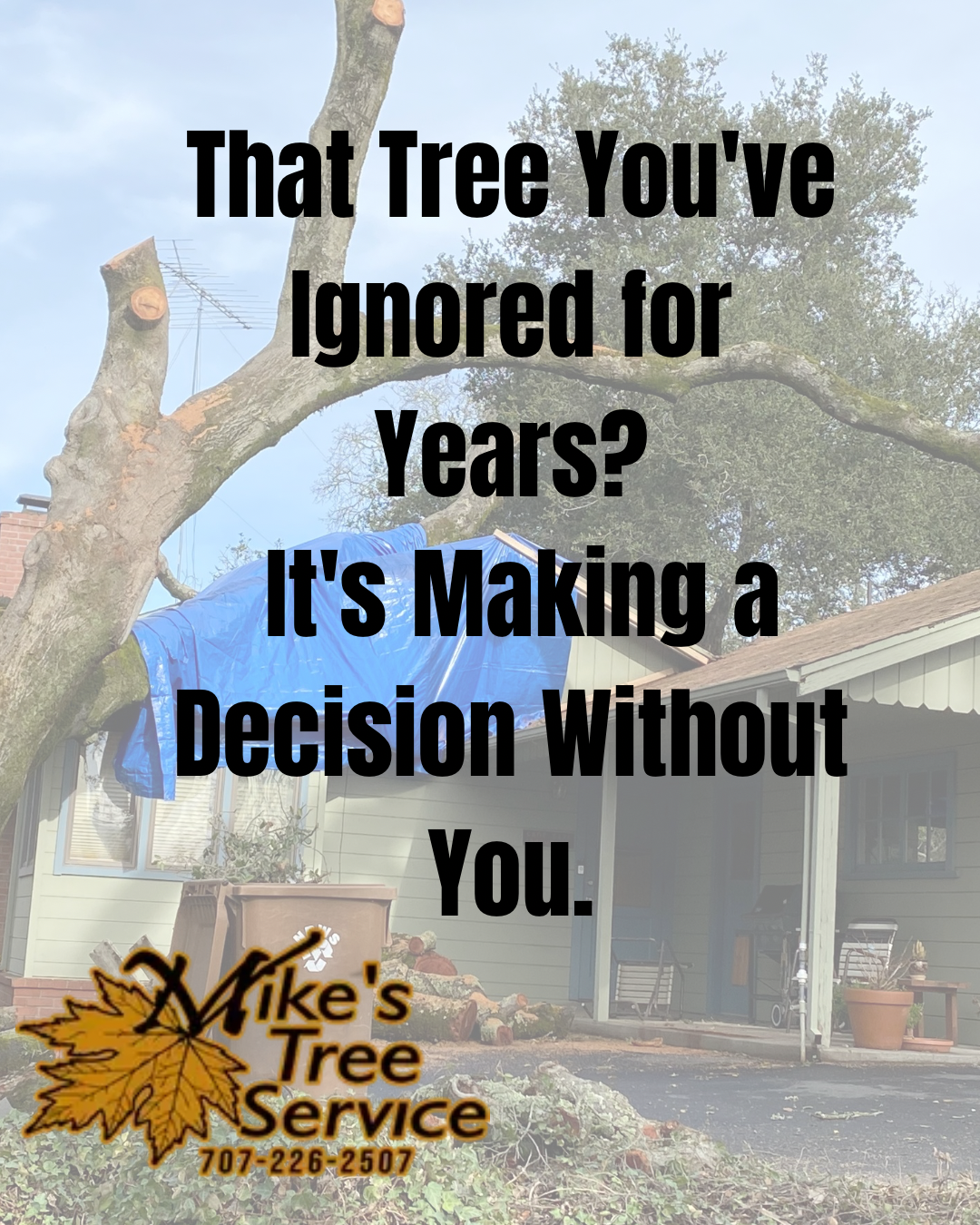
The Best Removal Decision Improves the Whole Property
The right answer is not always to keep the tree, and it is not always to remove it. The best decision is the one that improves the property as a whole.
What Should Be Part of the Decision
- Safety
- Tree health
- Shade
- Views
- Privacy
- Fire exposure
- Root conflicts
- Long-term maintenance
- Permit requirements
- Replacement potential
- How the property will function five or ten years from now
For a homeowner searching for tree removal near me in Napa Valley, the most useful assessment is one that explains those tradeoffs before equipment arrives.
The same principle applies to property owners considering
tree removal in Sonoma, CA, Kenwood, Glen Ellen, or other Sonoma County communities. Mature trees are too valuable, and removal is too permanent, for the decision to be based only on appearance or convenience.
Frequently Asked Questions
Does removing a tree increase property value?
Sometimes. Removing a hazardous, diseased, badly placed, or damaging tree can improve safety and functionality. Removing a healthy mature tree may reduce shade, privacy, curb appeal, or landscape maturity. The result depends on the specific tree and property.
Can pruning solve the problem without removal?
Often, yes. Structural pruning, deadwood removal, clearance pruning, and canopy management can solve many conflicts while preserving the tree's shade and landscape value. Professional tree trimming in Napa, CA may be the better option when the tree itself is healthy.
Should a drought-stressed tree be removed in August?
Not based on drought symptoms alone. Browning leaves, early leaf drop, and reduced growth may reflect seasonal stress. A professional evaluation should consider structure, roots, disease signs, canopy decline, and whether the condition is reversible.
Do I need a permit for tree removal in Napa or Sonoma County?
Possibly. Requirements vary by jurisdiction, species, tree size, zoning, and site conditions. Protected trees and oak woodland areas may require permits or additional review before removal.
Make the Decision Based on the Whole Property
One tree can influence safety, shade, privacy, views, fire exposure, and the character of a Napa Valley property at the same time. If the tree is declining, damaging the property, or creating a hazard, removal may protect long-term value. If the tree is healthy and the problem can be solved through pruning or better management, preservation may be the better investment.
Mike's Tree Service can evaluate the tree in the context of the entire property and help determine whether monitoring, pruning, or removal is the most practical long-term solution.