How to Choose the Right Tree for Your Napa Valley Property — A Species Selection Guide
The most expensive tree mistake a Napa Valley homeowner makes is usually made at the nursery, not in the garden. A Coastal Redwood that looks magnificent at the nursery in March. A Japanese Maple that seems perfect for the courtyard. A water-loving ornamental that catches the eye without a single thought given to what six months of dry Mediterranean summer will do to it once it's planted. Species selection in Napa Valley matters more than in almost any other California market — because the combination of summer drought, soil variability, vineyard root competition, and fire risk creates a planting environment where the wrong species doesn't just struggle. It fails, often expensively and irreversibly. Mike's Tree Service provides ISA certified species consultation throughout Napa Valley — and this guide covers everything a property owner needs to know before any tree is purchased or planted.
Why Species Selection Matters More in Napa Valley Than Most Regions
Most of California's planting advice is written for coastal climates, the Central Valley, or the Bay Area. Napa Valley is none of those things. The specific conditions here create a planting environment that generic California tree guides don't adequately address:
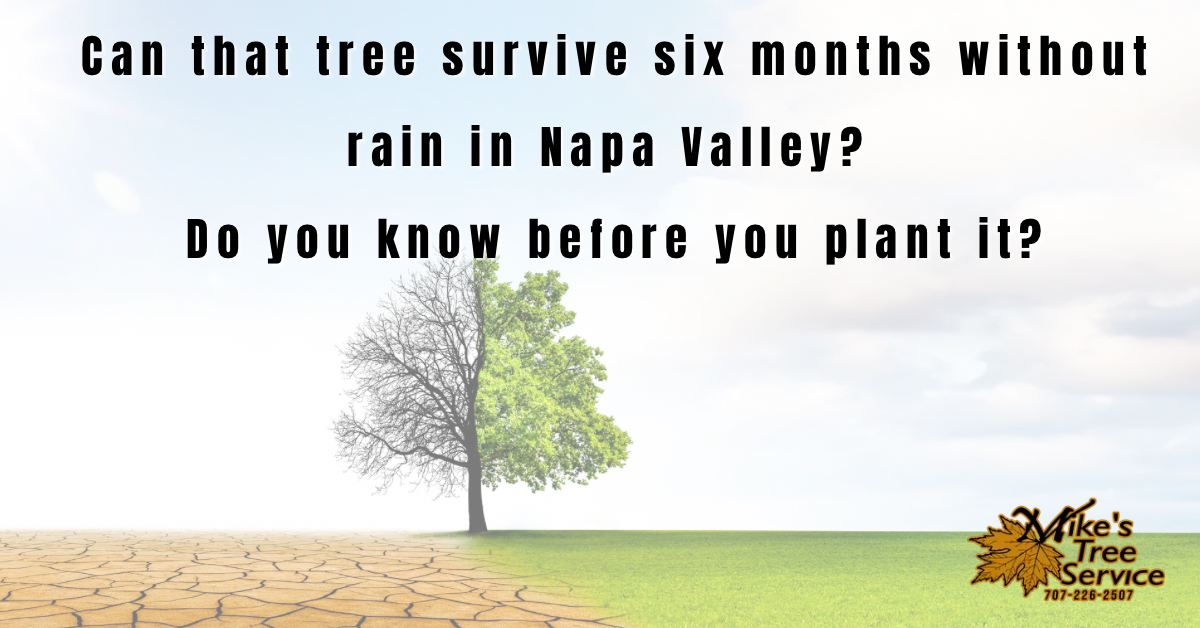
Six months of essentially zero rainfall Napa Valley's Mediterranean climate delivers nearly all of its annual precipitation between November and April. From May through October, a newly planted tree receives no natural rainfall — relying entirely on whatever moisture exists in the soil and whatever supplemental irrigation the property owner provides. A species selected without this reality in mind is starting under a water deficit that only intensifies through June, July, and August.
Dramatic soil variability across short distances Valley floor properties typically have heavy clay soils that hold moisture in winter and become impermeable in summer. Hillside properties have rocky volcanic soils that drain almost immediately and hold almost no moisture reserves. A tree appropriate for one of these soil profiles may fail rapidly in the other — and Napa Valley properties sometimes contain both within the same acreage. Site-specific assessment isn't a preference here. It's a requirement.
Vineyard root competition Established vineyard root systems are aggressive and extensive — dominating the top 6 to 12 inches of soil for significant distances from the vine rows. Any ornamental or shade tree planted in proximity to active vineyard blocks is competing against decades of root development for every available drop of moisture and nutrient. Species selection for vineyard-adjacent planting requires additional drought tolerance above and beyond what the climate alone demands.
Fire risk as a planting consideration Napa Valley's fire risk is not a peripheral concern — it's a fundamental planting variable. Species that carry flame, accumulate dead fuel load, or have high volatile oil content (California Bay Laurel near structures, for example) create fire risk that native fire-adapted species don't. Defensible space requirements under CalFire regulations affect which species are appropriate in which locations on the property.
Mediterranean Oak Borer and Sudden Oak Death pressure Drought-stressed trees are the primary targets of Mediterranean Oak Borer — and Sudden Oak Death (Phytophthora ramorum) continues to spread through Napa Valley's oak populations. Choosing species with appropriate drought tolerance reduces the stress vulnerability that makes trees targets for both threats. A tree planted in the wrong conditions for its species is a stressed tree — and a stressed tree in Napa Valley is a tree at elevated disease and pest risk.
Assess Your Site Before Choosing Any Tree
The site determines the species — not the other way around. Here's the evaluation framework Mike's Tree Service uses before recommending any species for a Napa Valley property:
Soil type — the most important variable Dig down 12 to 18 inches in the proposed planting location and examine the soil:
- Heavy clay — dark, dense, sticky when wet, hard when dry. Holds moisture but drains slowly and becomes compacted. Requires species that tolerate wet winters and dry, impermeable summers.
- Rocky volcanic or gravelly hillside soil — thin, fast-draining, low organic content. Dries rapidly. Requires deeply drought-tolerant species with established dry-season survival strategies.
- Alluvial loam — the most forgiving. Better structure, reasonable drainage, moderate moisture retention. The broadest species range.
Sun exposure — full vs. partial vs. afternoon shade Napa Valley's afternoon sun in summer is significantly more intense than morning sun — a tree receiving full western exposure from 2pm to 7pm in July and August is under significantly more heat stress than a tree receiving morning sun only. Assess the actual sun pattern for the planting location through the day — not just "sunny" or "shaded."
Drainage — wet winters are as relevant as dry summers A location that collects standing water during December through March eliminates species that can't tolerate wet root conditions during winter dormancy. This is particularly relevant for native oaks — Valley Oak and Coast Live Oak can handle summer drought beautifully but are susceptible to root rot from winter waterlogging if placed in low spots.
Water access — will this tree receive irrigation or not? Be honest about this. A tree that requires supplemental irrigation during its first three to five establishment years needs an irrigation system or a committed hand-watering program. If neither is realistic for the planting location, the species selection must be limited to those that can survive on rainfall alone after their first or second season.
Proximity to structures, utilities, and vineyard blocks
- Structures: overhead clearance for mature canopy, root system behavior near foundations
- Utilities: underground lines, overhead power — verify before planting anything with significant root spread or height
- Vineyard blocks: distance from vine rows determines how much root competition the tree will face
The site profile you need before shopping: Soil type + drainage + sun exposure + water access + proximity constraints = the planting envelope that determines which species have a realistic chance of thriving on this specific site.
Native California Trees That Thrive in Napa Valley
Native species evolved with Napa Valley's conditions — they're the most reliable performers for unirrigated or minimally irrigated planting:
Valley Oak (Quercus lobata) The iconic Napa Valley native. Deep taproot system accesses groundwater inaccessible to most other species. Extremely drought-tolerant once established — Valley Oaks in the wild survive Napa's summers without any supplemental water. Grows to magnificent scale over decades — a Valley Oak planted today becomes an heirloom tree for future generations.
Best for: Large properties with space for mature canopy spread, locations with adequate groundwater depth, heritage tree planting Placement consideration: Needs space — mature canopy spread can exceed 80 feet. Keep well away from structures and active vineyard blocks. Critical note: Never irrigate within 10 feet of the root crown in summer. Summer irrigation activates Phytophthora and Oak Root Fungus in otherwise healthy Valley Oaks.
Coast Live Oak (Quercus agrifolia) Evergreen native oak that provides year-round canopy and high wildlife value. More tolerant of coastal influence than Valley Oak. Similar drought adaptation once established — thrives on winter rainfall alone after the establishment period.
Best for: Year-round shade, wildlife habitat, natural landscaping Placement consideration: Smaller than Valley Oak but still significant — 30 to 50 foot mature canopy. Same summer irrigation restriction as Valley Oak.
California Buckeye (Aesculus californica) Deciduous native that handles Napa Valley's summer drought through an elegant adaptation — it goes fully dormant and drops its leaves in late summer, effectively hibernating through the driest months. Dramatic spring bloom. Completely drought-independent after establishment.
Best for: Native plant gardens, naturalistic hillside planting, properties without irrigation infrastructure Placement consideration: Deciduous in summer — expect bare branches from August through November, which surprises homeowners unfamiliar with the species. Not a concern — it's the tree performing correctly.
Toyon (Heteromeles arbutifolia) California's native holly — evergreen shrub to small tree with white summer flowers and bright red winter berries. Exceptional fire resistance. Drought-tolerant once established. Provides exceptional wildlife habitat value.
Best for: Defensible space planting, fire-resistant native gardens, wildlife planting Placement consideration: Typically 6 to 15 feet — appropriate for spaces where a full-size tree isn't suitable
California Bay Laurel (Umbellularia californica) Aromatic evergreen native with culinary uses. Drought-tolerant once established. Important caution for fire-risk properties — California Bay Laurel has high oil content and contributes to fire spread when placed immediately adjacent to structures. Appropriate in naturalistic planting away from structures and as part of mixed native plantings.
Placement consideration: Keep 30+ feet from structures on fire-risk properties. Do not plant as part of a fire-resistant landscape near the house zone.
Drought-Tolerant Non-Native Trees That Work in Napa's Climate
Several non-native species are reliably successful in Napa Valley's specific conditions — particularly for homeowners who want ornamental or architectural character beyond what natives offer:
Olive (Olea europaea) Perhaps the most compatible non-native for Napa Valley's Mediterranean conditions — Olive evolved in an almost identical climate in the Mediterranean basin. Silver-gray foliage, sculptural form, extraordinary drought tolerance, long-lived. Thrives on winter rainfall alone once established. Fruiting varieties require consideration on properties where dropped fruit and staining are a concern — ornamental varieties provide the aesthetic without the fruit management.
Best for: Mediterranean garden aesthetics, vineyard border planting, drought-independent ornamental trees Placement consideration: Moderate size — 20 to 30 feet at maturity. Appropriate for most residential planting locations.
Cork Oak (Quercus suber) European native oak with remarkable textural bark and genuine drought adaptation. Evergreen, fire-resistant, and compatible with Napa Valley's summer dry conditions. Slower growing than native oaks but long-lived and architecturally distinctive.
Best for: Feature planting, fire-resistant landscaping, Mediterranean character Placement consideration: 40 to 60 feet at maturity — adequate space required
Italian Cypress (Cupressus sempervirens) Columnar form that provides architectural definition and screening without significant canopy spread. Drought-tolerant once established. Extremely appropriate for Napa Valley's climate and visual character — widely used throughout wine country for vineyard drives and property boundaries.
Best for: Vineyard aesthetics, driveway definition, screening, windbreaks Placement consideration: Columnar form — significant height (40 to 70 feet) with minimal spread. Appropriate in tight spaces where canopy spread isn't possible.
Ginkgo (Ginkgo biloba) Ancient species with remarkable heat and drought tolerance once established. Spectacular gold fall color. Adaptable to clay soils with adequate drainage. Select male trees only — female trees produce fruits with a notoriously unpleasant odor.
Best for: Fall color, urban and residential settings, clay soil locations
Placement consideration: Slow-growing to 40 to 80 feet. Male cultivars labeled "Autumn Gold" or "Princeton Sentry" are the standard selection for residential planting.
Trees to Avoid in Napa Valley — And Why
These species appear regularly in Northern California nurseries and look appealing — but fail predictably in Napa Valley's specific conditions:
Coastal Redwood (Sequoia sempervirens) outside fog zones Coastal Redwoods are adapted to the consistent coastal fog that provides summer moisture in their native range. Napa Valley's inland climate doesn't provide that fog. Redwoods planted in valley floor or hillside locations away from consistent fog access experience summer drought stress that produces top-kill — dying from the crown downward — during dry years. They require massive supplemental irrigation to survive without fog, which is neither sustainable nor consistent with Napa Valley's water reality.
Water-loving maple species Japanese Maple (Acer palmatum), Silver Maple, and other moisture-dependent maples fail consistently in exposed Napa Valley locations without reliable irrigation. They scorch severely by mid-July, decline progressively, and rarely recover the aesthetic value they showed at the nursery. If a Japanese Maple is desired for a courtyard or sheltered location with afternoon shade and consistent irrigation access — it can work in those specific protected conditions. In an open, exposed location without reliable summer water — it will not.
Birch (Betula species) Birches are water-demanding species that evolved in moist, cooler climates. In Napa Valley's summer conditions they experience chronic drought stress, pest pressure from bronze birch borer (which specifically targets stressed birches), and typically fail within five to ten years. The aesthetic appeal at the nursery doesn't survive contact with a Napa summer.
Liquidambar (Sweet Gum) Aggressive surface root system that damages pavement, foundations, and irrigation infrastructure. The famous fall color is real — but so is the root damage, the persistent spiky fruit drop, and the maintenance burden. Better alternatives exist for fall color in Napa Valley.
Any species whose water requirement description at the nursery includes "regular summer water" If the plant tag says "regular water" or "moderate to regular water" — that species requires summer irrigation in Napa Valley for its entire life, not just during establishment. This is an irrigation commitment you're making for 30 to 50 years. Consider whether that commitment is realistic for the planting location before purchase.
Trees for Specific Napa Valley Situations
Sometimes the question isn't just "what grows here" but "what solves this specific problem":
Hillside erosion control Steep slopes in Napa Valley lose topsoil rapidly without adequate root systems to hold it. Species for hillside erosion planting need established root systems relatively quickly, tolerance for thin rocky soil, and drought adaptation.
- Toyon — native, fast-establishing, deep roots relative to size
- California Coffeeberry (Frangula californica) — native shrub-to-small tree, excellent erosion control
- Valley Oak — the long-term solution for significant slopes with adequate groundwater depth
Shade near structures Providing shade for structures reduces summer cooling costs meaningfully in Napa Valley's heat — but tree placement near structures requires species with non-invasive root behavior and appropriate mature size.
- Cork Oak — moderate size, non-invasive roots, appropriate proximity to structures
- Ginkgo (male) — slow-growing gives time to manage placement, non-invasive roots
- Olive — moderate size, good structural character, minimal root aggression
Fire-resistant species for defensible space CalFire's Zone 1 (0 to 30 feet from structures) requires fire-resistant planting. The characteristics that make species fire-resistant: high moisture content in leaves, low volatile oil content, minimal dead fuel accumulation.
- Toyon — native, fire-resistant, appropriate for Zone 1
- Cork Oak — fire-resistant bark, appropriate for defensible space planting
- Avoid: California Bay Laurel, Eucalyptus, and conifers in Zone 1
Vineyard border screening Screening along vineyard property lines serves visual, wind, and privacy functions while needing to be compatible with vineyard operations — no root competition with vine rows, appropriate height management.
- Italian Cypress — columnar form, no root competition issues, drought-tolerant
- Olive — moderate spread, compatible with vineyard aesthetics, drought-tolerant
- Cork Oak — more significant spread but appropriate for larger borders
Planting Timing and Establishment in Napa Valley
When you plant matters almost as much as what you plant:
The fall planting advantage Fall — October through December — is the optimal planting window for Napa Valley trees across almost all species. Here's why:
- Winter rain provides free irrigation through the establishment root-growth period
- Cooler soil temperatures reduce transplant stress
- Roots can develop through winter before the tree faces its first dry season
- A tree planted in October enters summer with 6 to 8 months of root development rather than facing summer drought on day 60
The spring planting risk Spring-planted trees in Napa Valley establish root systems and face their first dry season simultaneously — the worst possible combination for a tree that hasn't yet developed adequate deep root structure. Spring planting is manageable for drought-adapted species with a committed irrigation program. For species without reliable irrigation, fall planting is the responsible choice.
Establishment watering by category:
- Native oaks — minimal supplemental water during establishment; never at the root crown; allow the tree to develop drought adaptation from the first season
- California Buckeye — minimal; allow to go summer-dormant naturally even during establishment
- Non-native drought-tolerant species — moderate supplemental water during first two to three establishment seasons; taper significantly in years three to five as root system develops
- Ornamentals with moderate water needs — consistent supplemental irrigation during the entire establishment period; honest assessment of whether this is sustainable long-term
- What establishment mistakes look like: The most common establishment errors in Napa Valley aren't neglect — they're overwatering native species (triggering root rot), planting too deep (burying the root flare), and staking too long (preventing trunk development). For the complete guide to avoiding every establishment mistake, read our young tree care guide →
Mike's Tree Service: Species Selection Consultation for Napa Valley Properties
The consultation that happens before a tree is purchased is the most cost-effective tree service available — because it prevents the expensive mistakes that require intervention after the wrong species is already planted.
Mike's Tree Service provides pre-planting species consultation throughout Napa Valley — combining ISA certified arborist assessment of your specific site with detailed species recommendations matched to your actual conditions, not general California advice.
What a Mike's Tree Service species consultation includes:
| Consultation Component | What It Gives You |
|---|---|
| Site assessment | Soil type, drainage, sun exposure, water access, proximity constraints — evaluated before any species is recommended |
| Species recommendations | Native and non-native options matched to your specific site profile, desired function, and maintenance commitment |
| Placement guidance | Exactly where on the property each species works — and where it doesn't |
| Fire safety evaluation | Species and placement recommendations consistent with CalFire defensible space requirements |
| Vineyard compatibility assessment | Root behavior and drought competition analysis for vineyard-adjacent planting |
| Establishment plan | Watering schedule, mulching guidance, and staking protocol specific to your chosen species |
| What to avoid on your property | Species that appear appropriate but will fail given your site's specific conditions |
| Connection to ongoing care | Pruning, fertilization, and health monitoring as the tree establishes — Mike's manages the full relationship |
The goal is to put the right tree in the right place on the first attempt. A species consultation before purchase costs a fraction of what young tree assessment, replacement, and potential removal costs after the wrong choice fails.
Contact Mike's Tree Service today to schedule your Napa Valley species selection consultation before you plant.
Schedule Your Species Consultation →
Read: Top Mistakes Homeowners Make With Young Trees in Napa Valley →
Read: Oak Tree Care in Napa Valley →
Read: How to Protect Your Napa Valley Trees During Drought Season →