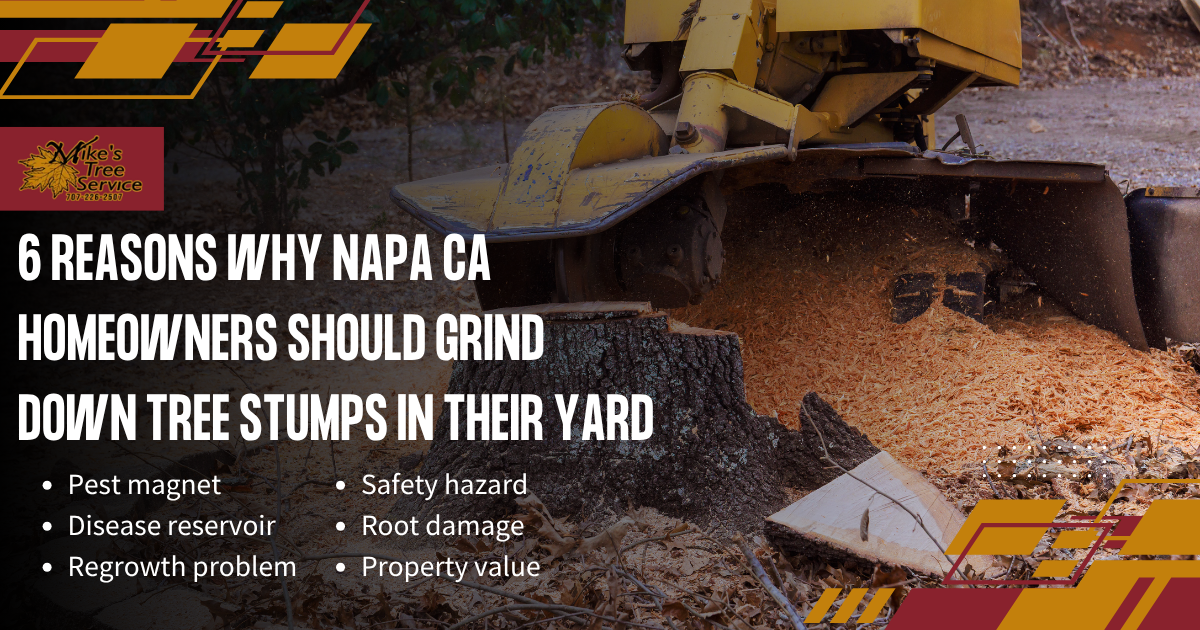
6 Reasons Why Napa CA Homeowners Should Grind Down Tree Stumps in Their Yard
After a tree comes down on a Napa Valley property, the stump that remains tends to become invisible. It stops registering as a problem. Other priorities take over. Something to mow around, something to deal with eventually.
What most homeowners do not realize is that the stump is not just sitting there. It is decaying, attracting pests, potentially spreading disease to nearby trees, and in some cases actively growing back. On properties in Napa, Yountville, Glen Ellen, Kenwood, and throughout Sonoma County, where mature oaks, ornamental trees, and vineyard plantings represent significant long-term value, what happens to a stump directly affects everything else on the property.
Why Napa Valley Stumps Are More Problematic Than Most
| Local condition | Why it makes stumps worse |
|---|---|
| Clay-heavy soils | Retain moisture, accelerating decay and fungal growth |
| Long warm summers | Speed up pest establishment and spread |
| Proximity to native oaks | Higher Armillaria disease transmission risk |
| Vineyard plantings nearby | Multiple susceptible hosts within root contact distance |
| High property values | Every square foot of landscape matters |
Reason 1: Stumps Attract Pests That Move Toward Your Healthy Trees and Home
A decaying stump becomes active habitat for termites, carpenter ants, and wood-boring beetles. Once established, these pests do not stay in the stump. They spread to nearby structures, healthy trees, and other wooden elements of the property.
In an environment where the
Mediterranean Oak Borer was first detected in Napa County in 2019 per UC ANR, a nearby decaying stump that harbors wood-boring insects adds pest pressure that surrounding trees cannot afford.
| Warning sign | What it indicates |
|---|---|
| Sawdust-like frass at the stump base | Active wood-boring beetle or ant activity |
| Small pinholes or galleries in the wood | Established beetle galleries inside the stump |
| Winged insects swarming in spring | Termite or ant colony reproducing from the stump |
| Soft, spongy wood near the base | Advanced decay creating ideal pest habitat |
Reason 2: Stumps Spread Armillaria Root Rot to Surrounding Healthy Trees
This is the highest-stakes reason for Napa Valley and Sonoma County properties with established tree canopies.
According to
UC IPM's Armillaria guidance, the fungus persists in infected roots and stumps and spreads by root-to-root contact, often creating a widening circle of dead trees.
UC ANR confirms that removing stumps slows spread by reducing inoculum available to reach healthy root systems.
| Why Napa Valley is especially at risk | Detail |
|---|---|
| Clay soils retain moisture | Promotes Armillaria growth year-round |
| Fungus survives in stumps | Remains active long after the tree is gone |
| Multiple susceptible hosts | Oaks, ornamentals, and vineyard rootstocks all at risk |
| No registered fungicides in California | Prevention is the only effective strategy |
A stump left in place is not inert. If Armillaria is present, it is an active reservoir. Stump grinding to 6 to 12 inches below grade removes the primary source of fungal spread.
Reason 3: Stump Regrowth Creates Ongoing Maintenance and Future Removal Cost
California bay laurel, certain oak species, and many ornamentals common in Glen Ellen and Kenwood are documented resprouters. Their root systems remain alive after the trunk is cut and send up suckers repeatedly from stored root energy. These suckers do not develop into healthy trees. They create a dense, structurally inferior thicket requiring management every growing season.
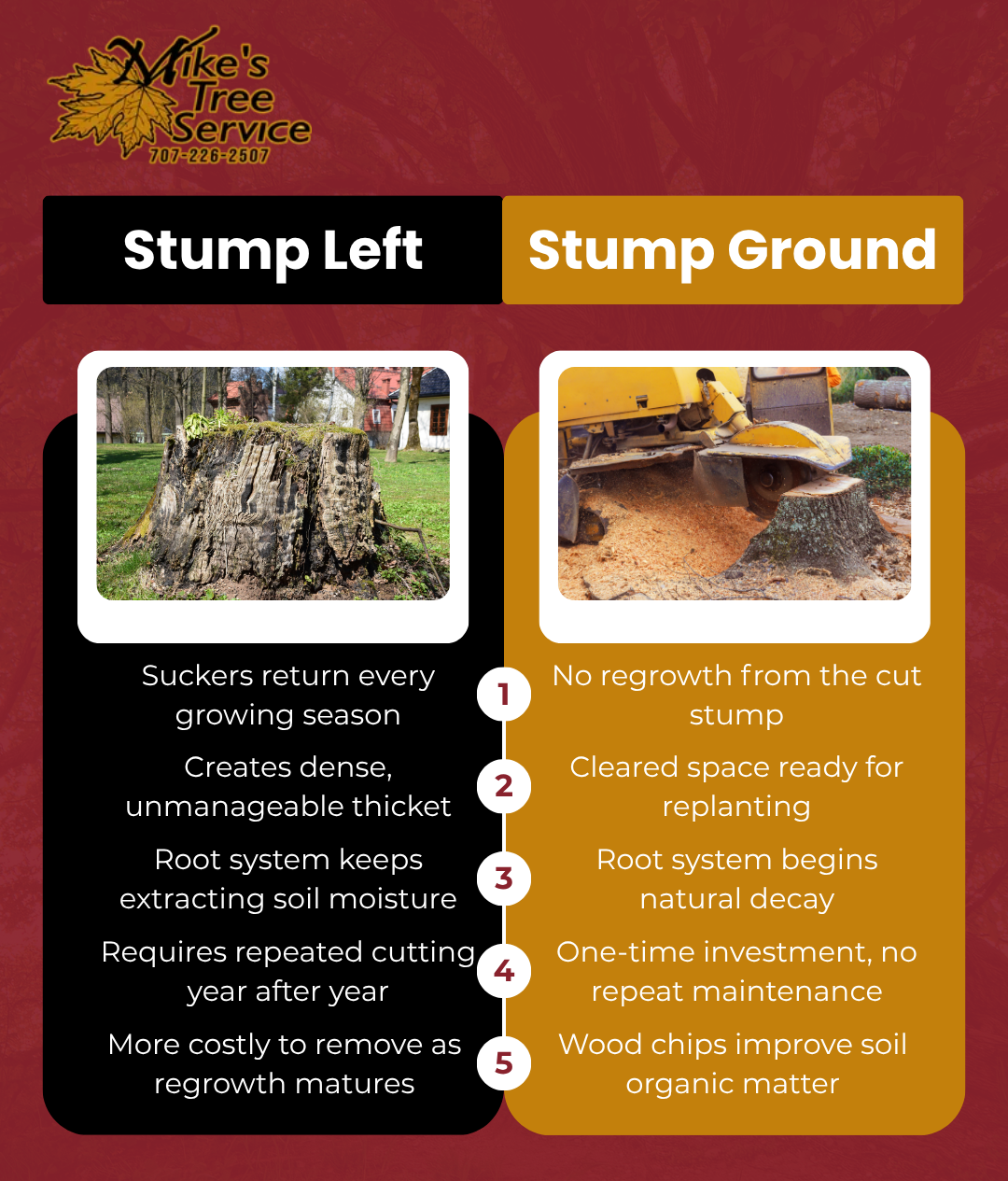
Stump grinding to 6 to 12 inches below grade eliminates the above-ground mass from which most sucker growth originates. The wood chips can be left in place to improve soil organic matter or removed from the site.
Reason 4: Stumps Are a Safety and Liability Hazard
A stump covered by grass or ground cover is invisible to anyone unfamiliar with the yard. That invisibility is the hazard.
Who is most at risk on a Napa Valley property:
- Adults walking shaded areas in low light
- Children running during gatherings
- Guests, vendors, and estate workers unfamiliar with the grounds
- Equipment operators who contact the stump at speed
The liability reality: California property owners have a duty to maintain their property in a reasonably safe condition for visitors. An obscured stump that has been present for an extended period is a known hazard. If a visitor or contractor is injured, its documented presence is relevant to any liability determination.
Reason 5: Stump Root Systems Damage Hardscape and Underground Infrastructure
The visible stump is the smaller part of the problem. The root system below grade continues to be present and in some species remains actively growing after the trunk is removed.
| What gets damaged | How it happens |
|---|---|
| Stone patios and vineyard paths | Roots expanding in diameter lift and crack surface materials |
| Drip irrigation and soaker lines | Roots follow moisture into emitters and supply connections |
| Retaining walls | Lateral root pressure separates stone and mortar joints |
| Building foundations | Clay soil moisture differentials from root activity contribute to settling |
Stump grinding disrupts the root system's connection to a food source, beginning the decay process that progressively eliminates root mass over the following seasons without the excavation required for full stump removal.
Reason 6: Stumps Reduce Property Value and the Appeal of a Napa Valley Landscape
In Napa Valley and Sonoma County, landscape presentation is directly tied to property value. A decaying stump:
- Interrupts the visual continuity of an otherwise well-maintained landscape
- Signals deferred maintenance to potential buyers and estate managers
- Occupies ground that cannot be planted, paved, or used productively
After professional grinding, the cleared area can be seeded, planted, or incorporated into a hardscape design within one growing season.
What Professional Stump Grinding Involves
Stump grinding uses a rotating cutting wheel with carbide teeth to reduce the stump to wood chip material, typically grinding to 6 to 12 inches below grade. The process is faster and less disruptive than full stump removal, which requires excavating the entire root ball.
| Step | What happens |
|---|---|
| Site assessment | Stump species, diameter, root proximity to hardscape and irrigation confirmed |
| Chip preference | Left in place to decompose or removed from site |
| Grinding | Reduced to below grade at depth appropriate to species and planned use |
| Cleanup | Area reviewed with property owner before crew departs |
For stumps on properties with established native oaks or vineyard plantings where Armillaria or other disease transmission is a specific concern, Mike's Tree Service can include a tree health assessment of the surrounding trees as part of the stump grinding visit.
Should This Stump Be Ground?
| Situation | Recommendation |
|---|---|
| Stump near established oaks or vineyard plantings | Grind promptly. Armillaria transmission risk |
| Stump showing mushroom clusters at base | Grind and evaluate surrounding trees immediately |
| Stump in a high-traffic area of the yard | Grind. Active safety hazard |
| Stump within 10 feet of hardscape or irrigation | Grind. Root system activity risk |
| Small stump in isolated corner, no nearby trees | Monitor, but grind before replanting the area |
| Stump with visible sucker regrowth | Grind. Regrowth will continue without grinding |
Frequently Asked Questions
For stumps on properties with established native oaks or vineyard plantings where Armillaria or other disease transmission is a specific concern, Mike's Tree Service can include a tree health assessment of the surrounding trees as part of the stump grinding visit.
How deep does stump grinding go?
Professional stump grinding typically reaches 6 to 12 inches below grade, which is sufficient to prevent most regrowth and to allow the area to be replanted or repaved. For stumps where roots are near irrigation or hardscape, the depth and horizontal extent of grinding can be adjusted accordingly.
Can I plant in the area after stump grinding?
Yes. The wood chip material left after grinding can be mixed into the soil where it decomposes and adds organic matter over time. For the first growing season, some settling is normal as the chips break down. New plantings can typically go in within a few weeks to months depending on the species and the homeowner's timeline.
How long does stump grinding take?
Most residential stumps take 30 minutes to two hours to grind depending on diameter, species, and access. Multiple stumps on the same property can often be completed in a single visit.
Does stump grinding kill the roots?
Grinding removes the stump and disrupts the root system's connection to a food source, which causes the roots to begin dying back over time. It does not remove all root mass immediately. On properties with Armillaria concerns, Mike's Tree Service can discuss additional management options.
What happens to the wood chips?
The chips can be left in the ground to decompose, spread as mulch in nearby planting areas, or removed from the property entirely. Dan and the team discuss the property owner's preference before the work begins.
Is stump grinding necessary if the tree was healthy?
Even stumps from healthy trees decompose and attract pests over time, can produce regrowth, and create safety hazards. The disease transmission risk is lower without a pathogen present, but the pest, regrowth, safety, and aesthetic reasons for grinding still apply.
If you're noticing signs of decline or storm damage on your Napa Valley property, or if you have stumps from recently removed trees, Mike's Tree Service can evaluate your trees and help you determine whether pruning, treatment, stump grinding, or removal is the best long-term solution for your property.