Licensed Tree Service vs Unlicensed Tree Contractor: What Napa Homeowners Should Know Before Hiring
For estimated planning context, tree trimming can range from a few hundred dollars for smaller jobs to more than $1,000 for extensive work. This broad average range can vary significantly based on tree size, location, access, complexity, proximity to structures or power lines, and whether specialized climbing or equipment is required.
At Mike's Tree Service, we price the actual project after looking at the tree, the work being requested, the surrounding property, and the safest way to complete it. Two trees of similar height can require very different amounts of labor when one is in an open yard and the other is over a roof, pool, vineyard, driveway, or utility area.
| Scope | Estimated 2026 market context | How to interpret it |
|---|---|---|
| Targeted brush clearing | Site-specific estimate recommended | Area, vegetation density, access, and debris handling determine the scope |
| Professional land clearing | $1,396 to $6,170 per acre | Broad national planning range reported in Angi's 2026 land-clearing cost guide, not Mike's Tree Service pricing |
| Mike's Tree Service property estimate | Free estimate | Final pricing depends on the inspected scope |
A lower tree-service quote can be tempting when the work appears as simple as cutting a branch or removing one tree. The real comparison is not only about price. It is about who is qualified, who is responsible if something goes wrong, and whether the scope protects your property and the tree. Before hiring in Napa, compare licensing, insurance, safety planning, written terms, and cleanup expectations together.
At Mike’s Tree Service, we have served Northern California since 1968 and provide licensed, insured tree care. Homeowners often must choose between a detailed estimate and a cheaper verbal offer. A license does not automatically make every contractor equally skilled, but it creates important verification options. This guide will help you choose a tree service based on evidence rather than promises alone.
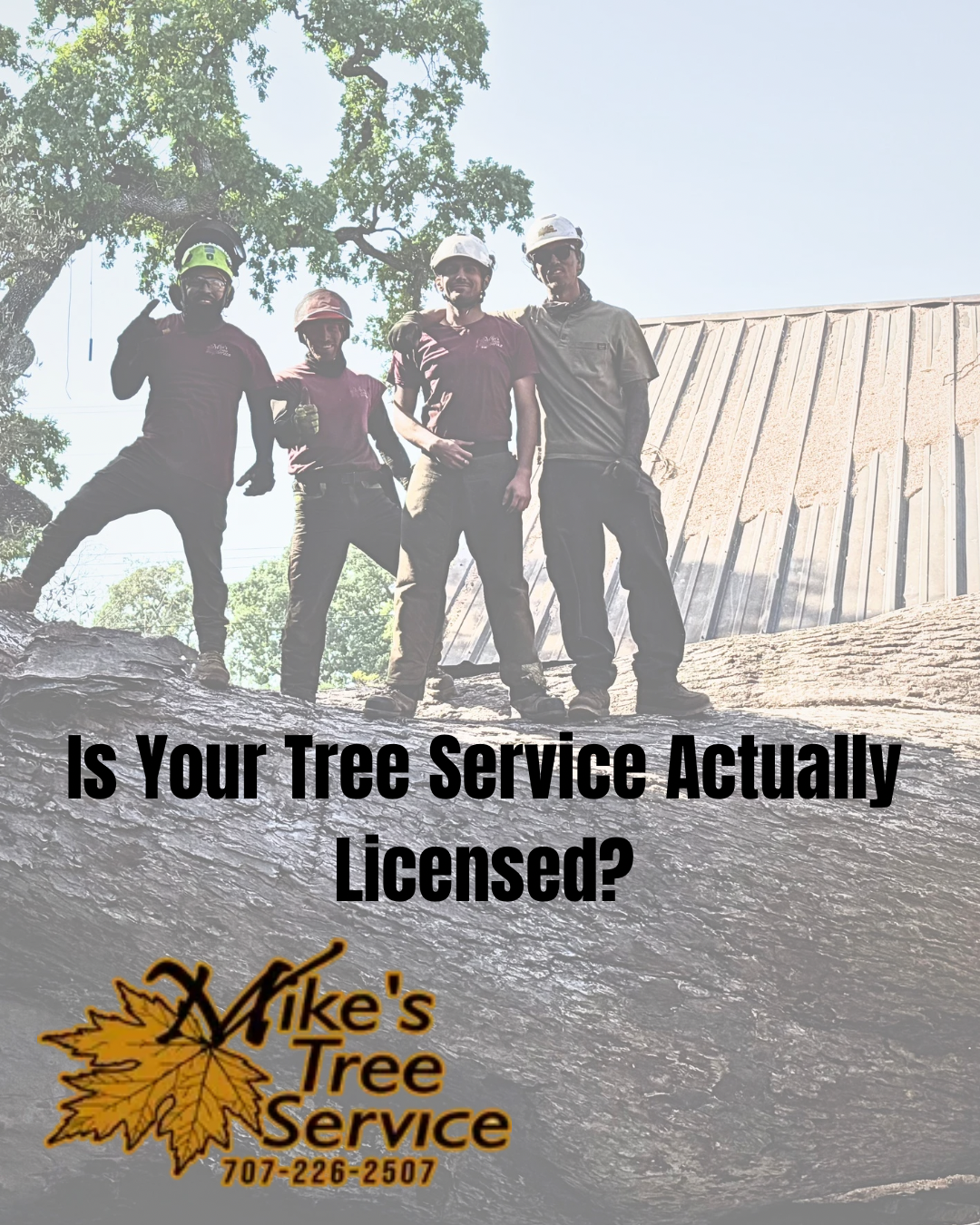
Why Licensing Matters for Tree Work in Napa
Tree work can place people, roofs, vehicles, fences, utilities, and neighboring properties inside the drop zone. A large limb may weigh hundreds of pounds, and a damaged trunk can react unpredictably. Professional crews plan around lean, decay, access, rigging, equipment, and the path each piece will follow. Licensing does not remove those hazards, but it provides a public record to verify before work begins.
California’s contractor system creates accountability that an unlicensed operator may not provide. Homeowners can check license status, classification, bond information, and available workers’ compensation details. Those checks are valuable for removals, major pruning, stump grinding, and elevated work. A cash quote or social media profile cannot replace them.
Licensed Tree Service vs Unlicensed Contractor at a Glance
Not every licensed contractor is perfect, and an unlicensed person may still have tree knowledge. The key difference is that a properly licensed business can be checked against state records. An unlicensed offer provides fewer ways to confirm qualifications, insurance, responsibility, or recourse. Use this comparison as a screening tool, then verify each claim.
| Hiring factor | Licensed tree service | Unlicensed tree contractor |
|---|---|---|
| License status | Can be verified through California’s CSLB database | No active contractor license to verify |
| Work classification | Record shows the classification connected to the business | Scope may not be tied to a recognized classification |
| Insurance review | Certificates and policy details can be requested and checked | Coverage may be absent, limited, expired, or difficult to confirm |
| Written scope | More likely to define pruning, removal, equipment, debris, and exclusions | May rely on a short quote or verbal agreement |
| Safety planning | Crew roles, drop zones, rigging, equipment, and access can be planned | Methods may be unclear until work starts |
| Accountability | Business identity and license history are publicly traceable | Recourse may be limited if the operator disappears |
| Price | May reflect trained labor, equipment, insurance, and controlled cleanup | May appear lower because important protections or tasks are excluded |
Do not stop at the word “licensed.” Confirm that the proposal matches the state record, the license is active, and the classification is appropriate. Request current insurance documentation instead of accepting a logo or verbal assurance. A responsible contractor should explain who will perform the work and how the site will be protected.
What California Tree Service Licensing Actually Covers
The California Contractors State License Board says the current C-49 Tree and Palm Contractor classification covers planting, maintenance, removal, pruning, stump grinding, and guying. Some CSLB materials still reference the earlier C-61/D-49 Tree Service designation, so homeowners may see both terms. The classification also recognizes limited exceptions for certain incidental pruning. Verify the specific project through CSLB instead of assuming every task is treated identically.
Before accepting an estimate, use the state’s Check a License tool and review more than the license number. Confirm:
- The business name matches the company giving you the proposal.
- The license is active and current, not expired, suspended, or associated with someone else.
- The listed classification is appropriate for the proposed tree work.
- The bond information shown on the record is current.
- The workers’ compensation entry is consistent with the company’s staffing and license record.
- The address and contact information do not reveal unexplained inconsistencies.
A contractor’s license is different from an arborist credential. Licensing concerns the contracting framework, while arborist certification can demonstrate tested tree-care knowledge. If someone claims an ISA credential, use the International Society of Arboriculture’s verification directory. Ask whether that person will assess the tree or supervise the work.
Insurance and Worker Protection Deserve Separate Verification
A contractor license, liability insurance, workers’ compensation coverage, and a contractor bond are not interchangeable. Liability coverage may address certain property damage or third-party claims, while workers’ compensation addresses employee injuries under applicable terms. A contractor bond offers different, limited protection and does not replace liability insurance. Request evidence of each applicable protection and verify important coverage.
Tree work routinely involves climbing, chainsaws, chippers, lifts, ropes, and falling material near structures. The California Department of Industrial Relations maintains dedicated Cal/OSHA tree-work safety resources. If someone is injured or property is damaged, saying the crew is “covered” may not identify the employer or applicable policy. Verify the details before the crew arrives.
How a Professional Tree Service Plans the Work
A professional estimate should reveal how the contractor thinks, not only what the job costs. A tree trimming plan should identify the limbs, reasons, and intended outcome. A tree removal plan should address condition, lean, nearby targets, access, equipment, debris, and stump options. Clear reasoning helps prevent unnecessary removal or damaging cuts.
Before work begins, ask the contractor to explain:
- What will be cut or removed, including the specific tree and marked branches when needed.
- Why the work is recommended and whether a less aggressive option is reasonable.
- How the tree will be accessed, such as climbing, aerial lift, crane, or ground equipment.
- How limbs and trunk sections will be controlled around buildings, landscaping, and neighboring property.
- Who is responsible for utility coordination, permits, and traffic control when those issues apply.
- What cleanup includes, such as hauling brush, cutting firewood, raking, stump grinding, or chip removal.
- What is excluded, including landscape repair, underground utilities, or restoration after heavy equipment access.
The site plan should also change when conditions change. A cracked trunk, concealed decay, unstable root plate, soft access route, or unexpected utility conflict can affect the safest method. The contractor should stop, explain the new condition, and document any change in scope or price before continuing. That process is more dependable than improvising without homeowner approval.
Why the Cheapest Tree-Service Quote May Not Be the Lowest Cost
We provide
free, project-specific estimates because tree size alone cannot define a safe scope. Height, trunk diameter, species, condition, lean, access, rigging, equipment, utilities, structures, debris volume, and emergency timing all affect the work. For independent planning context, HomeGuide’s 2026 guides list tree removal at about $400 to $1,200 on average, tree trimming at about $400 to $900 per tree, and stump grinding at about $120 to $400 for the first stump. These national figures are not our prices or a Napa estimate.
| Service or cost factor | Independent planning context | Why a local estimate can differ |
|---|---|---|
| Tree removal | About $400 to $1,200 on average | Large, unstable, confined, or crane-assisted removals can require more labor and equipment |
| Tree trimming | About $400 to $900 per tree on average | Canopy size, pruning objective, access, and disposal affect the scope |
| Stump grinding | About $120 to $400 for the first stump | Diameter, wood hardness, root flare, depth, access, and debris handling matter |
| Rigging and equipment | Included differently by contractor | Aerial lifts, cranes, loaders, chippers, and traffic control can change the project plan |
| Cleanup and restoration | May be included, optional, or excluded | Hauling, chips, logs, stump debris, raking, and surface repair should be stated in writing |
A lower bid may be legitimate when the method is simpler or the contractor already has equipment nearby. It may also exclude hauling, stump work, permits, traffic control, property protection, insurance costs, or enough crew members to control the work safely. Compare the written scope line by line and ask the contractor to explain major price differences.
A cheap incomplete proposal can become expensive when damage, unfinished cleanup, improper pruning, or a second contractor is added later.
A Decision Framework for Choosing a Tree Contractor
The best hiring decision comes from documented evidence, not pressure or polished marketing. Start by defining the problem: a dead limb over the driveway, a tree leaning after rain, clearance from a roof, or removal for a construction project. Then request estimates that solve the same problem, because quotes cannot be compared fairly when each contractor proposes different work. Keep the decision focused on safety, tree health, property protection, and a complete finish.
| Decision question | Evidence to request | Warning sign |
|---|---|---|
| Is the contractor properly licensed? | Active CSLB record matching the business name | Borrowed, expired, missing, or mismatched license number |
| Is insurance current? | Certificate with insurer, policy dates, and applicable coverage | “We are covered” without documentation |
| Is the recommendation justified? | Explanation tied to condition, structure, clearance, or project needs | Immediate removal recommendation without an assessment |
| Is the work clearly defined? | Written trees, branches, equipment, cleanup, exclusions, and price | Verbal scope or one-line cash quote |
| Can the crew control the site? | Access plan, drop zones, rigging method, and protection measures | No clear answer about buildings, vehicles, or neighbors |
| Are payment terms reasonable? | Written schedule connected to the work | Large cash demand or pressure to pay before details are settled |
Use these questions before signing:
- Can I verify your license under the exact business name on this proposal?
- Can you provide current liability and workers’ compensation information?
- Who will supervise the project, and what experience does the crew have with this type of tree?
- Will you use climbing, an aerial lift, a crane, or another method, and why?
- Are permits, utility coordination, hauling, stump work, and final cleanup included?
- How will change orders be handled if hidden decay or access problems are discovered?
- When is payment due, and will I receive a signed copy of the agreement?
California’s CSLB guidance for finding the right contractor recommends checking license status and explains how bond and workers’ compensation information appears in the license record. Its contract guidance also emphasizes clear financial terms and written change orders. These checks take only a few minutes and create a much stronger basis for comparing contractors. If a provider resists basic verification, treat that resistance as information.
Napa Valley Properties Add Site-Specific Hiring Questions
Tree-service planning changes across Napa Valley even when the hiring standards remain the same. A compact Napa neighborhood may require careful rigging around roofs, fences, service lines, parked vehicles, and limited equipment access. Properties in Yountville or St. Helena may add mature landscaping, guest areas, vineyards, narrow drives, or operating-hour restrictions that affect staging and cleanup. In Calistoga, larger lots, heat exposure, fire-conscious vegetation management, and rural access can influence equipment selection and debris handling.
Local familiarity helps, but it should support documentation rather than replace it. Ask whether the contractor has handled similar tree species, slopes, access limits, and surrounding property uses, then request a plan tailored to your site. Permit and utility questions should be checked for the exact address because city, county, easement, protected-tree, and power-line conditions can differ. The right proposal should feel specific to your property, not copied from a generic price sheet.
Frequently Asked Questions
Does a contractor license prove that every tree recommendation is correct?
No. A license provides a verifiable legal and business framework, but it does not replace a careful tree assessment or guarantee that every recommendation is ideal. Ask the contractor to explain the condition, objective, alternatives, and consequences of waiting. For complex health or structural questions, request the qualifications of the person making the recommendation.
How can I verify a California tree contractor’s license?
Use CSLB’s online license search and enter the number shown on the proposal, vehicle, advertisement, or business materials. Confirm that the business name, status, classification, bond, address, and other displayed details align with the contractor you are considering. Do not accept a screenshot as the only proof because status can change. Check the live record close to the date you hire.
Is being insured the same as being licensed?
No. Licensing, liability insurance, workers’ compensation, and bonding serve different purposes. A company can say it is insured without explaining the policy type, limits, exclusions, or effective dates. Request documentation and verify important coverage directly. Homeowners should understand each protection instead of relying on one general claim.
Should I hire the lowest bidder for routine trimming?
Choose the lowest bid only after confirming that the contractors are pricing the same scope and offering comparable protections. One estimate may include correct pruning, full cleanup, insurance, and enough crew members, while another may only include cutting visible branches. Improper pruning can create weak regrowth, decay openings, poor structure, and future expense. Value comes from the result and risk control, not the initial number alone.
What should a written tree-service estimate include?
It should identify the property, trees, recommended work, equipment or access assumptions, debris handling, stump treatment, exclusions, schedule, and price. The document should also explain payment timing and how changes will be approved. For pruning, it should be clear whether the goal is deadwood removal, clearance, thinning, reduction, or another objective. For removal, clarify whether logs, chips, stump grinding, and surface restoration are included.
What if a contractor wants to begin immediately after giving a verbal quote?
Pause long enough to verify credentials and put the scope in writing. Urgency can be appropriate when a tree presents an immediate hazard, but urgent work still benefits from clear responsibility, insurance, methods, and payment terms. Move people and vehicles away from a dangerous area while arranging qualified help. Do not let pressure prevent basic checks that protect your household and property.
Hire With Confidence, Not Guesswork
Choosing between a licensed tree service and an unlicensed contractor is ultimately a decision about verifiable qualifications, safety planning, property protection, and accountability. We encourage Napa homeowners to check the license record, request insurance information, compare written scopes, and ask how the crew will control the work. Those steps are useful whether the project involves one dead branch, structural pruning, stump grinding, or a complex removal. A well-defined project gives you a better result and makes the estimate easier to understand.
If you need help evaluating a tree in Napa, Yountville, St. Helena, or Calistoga, contact Mike’s Tree Service for a free onsite estimate. We will inspect the tree and access conditions, explain what should be done, and define the work before the project begins. Our team provides professional tree trimming, removal, stump grinding, and land clearing backed by decades of local experience. Request your estimate and make your hiring decision with clear information.