Can a Cracked Tree Be Saved Before Napa Valley’s Winter Storms?
For estimated planning context, tree trimming can range from a few hundred dollars for smaller jobs to more than $1,000 for extensive work. This broad average range can vary significantly based on tree size, location, access, complexity, proximity to structures or power lines, and whether specialized climbing or equipment is required.
At Mike's Tree Service, we price the actual project after looking at the tree, the work being requested, the surrounding property, and the safest way to complete it. Two trees of similar height can require very different amounts of labor when one is in an open yard and the other is over a roof, pool, vineyard, driveway, or utility area.
| Scope | Estimated 2026 market context | How to interpret it |
|---|---|---|
| Targeted brush clearing | Site-specific estimate recommended | Area, vegetation density, access, and debris handling determine the scope |
| Professional land clearing | $1,396 to $6,170 per acre | Broad national planning range reported in Angi's 2026 land-clearing cost guide, not Mike's Tree Service pricing |
| Mike's Tree Service property estimate | Free estimate | Final pricing depends on the inspected scope |
A cracked tree trunk can mean a bark injury or serious separation in load-bearing wood. Some trees remain stable with corrective care, while others can fail without much warning. Depth, decay, branch structure, exposure, and nearby targets cannot be judged from one photograph. The safest question is whether the tree can retain acceptable structural reliability.
That distinction matters as Napa Valley moves toward wetter, windier weather. Soft soil and storm loads can expose weaknesses that seemed stable in calm conditions. Homeowners in Napa, Yountville, St. Helena, and Calistoga should control access and arrange a
tree inspection after finding a new split. This guide explains when preservation may be possible and when removal becomes more likely.
What Does a Crack in a Tree Trunk Actually Mean?
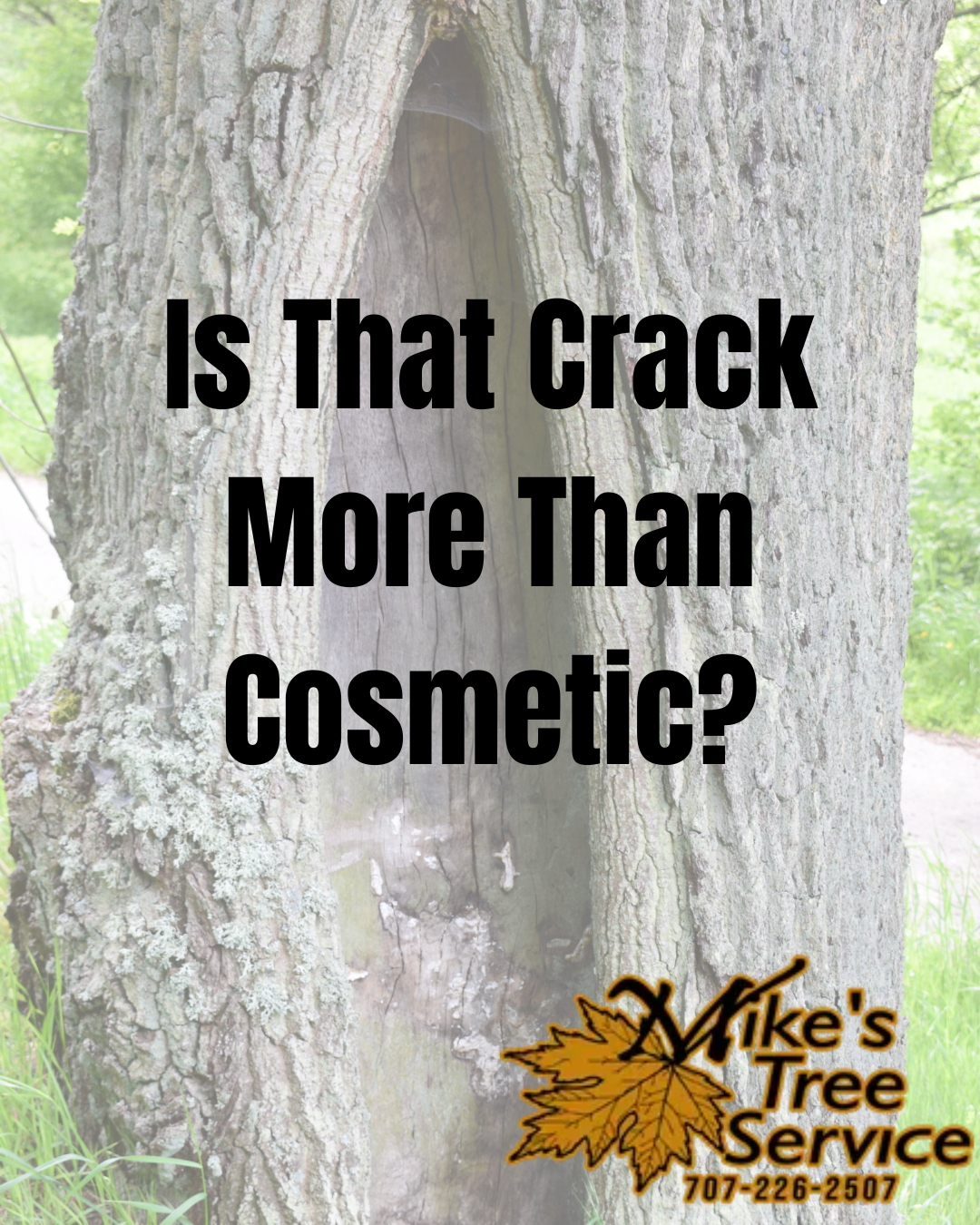
A crack is an opening whose effect depends on what separated and where. UC Agriculture and Natural Resources distinguishes bark-only cracks from deep cracks extending into wood. Deep separation weakens the structure that resists gravity, wind, and crown movement. A crack through a trunk or main union can matter more than a shallow one-sided wound.
Not every line in bark is an emergency. Natural bark, old wounds, sun injury, cankers, and growth stress may resemble a fresh
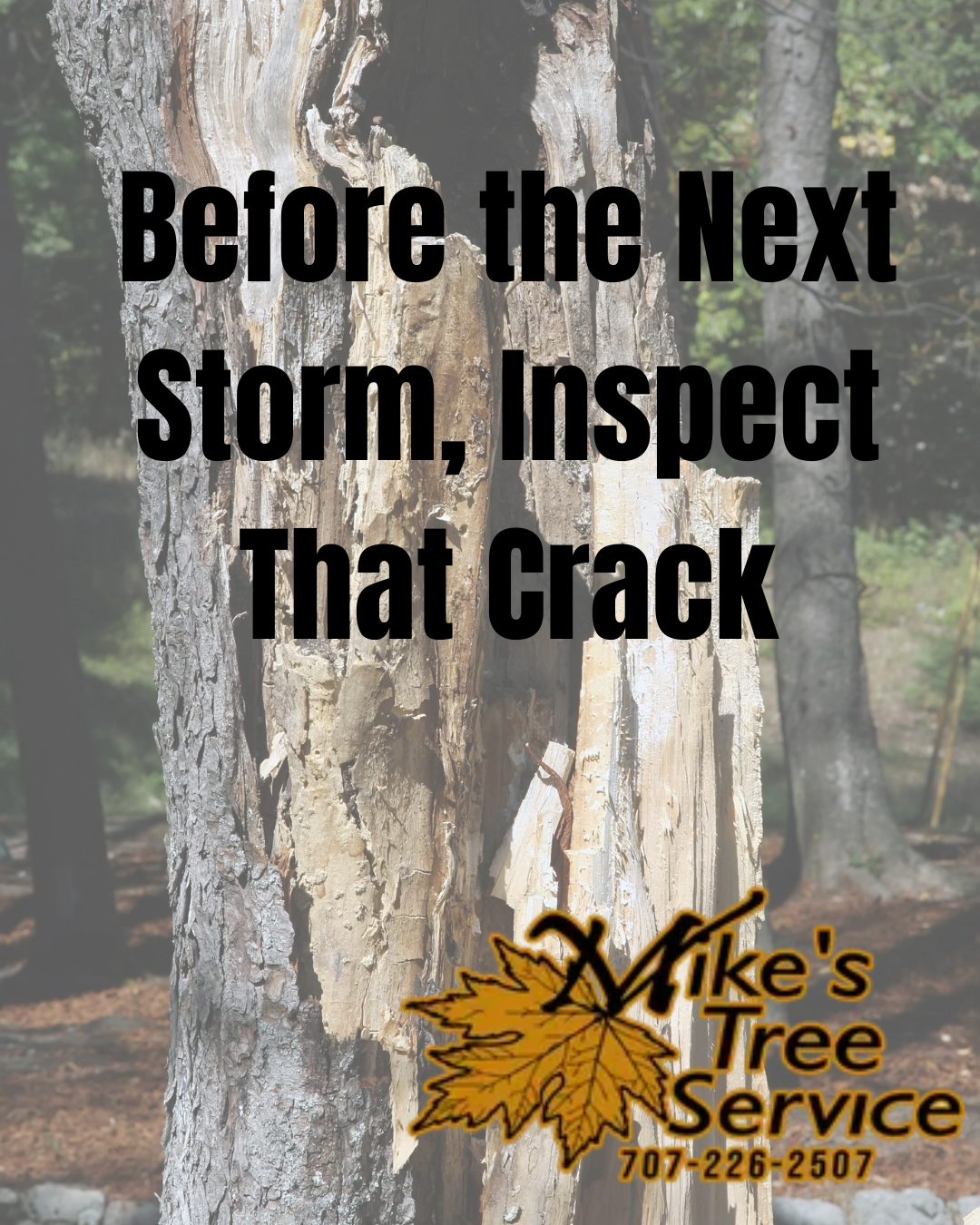
split tree trunk. Concern rises when the opening is new, widening, sounding, exposing inner wood, or beside decay. Document clues from the ground without probing deeply, climbing, or standing beneath the split.
| What you observe | What it may indicate | Appropriate next step |
|---|---|---|
| Fine line limited to outer bark | Superficial bark change or older injury | Photograph, date, and monitor for change |
| Deep opening into wood | Structural separation | Keep people away and request prompt inspection |
| Crack at a narrow two-stem union | Weak attachment or included bark | Assess both stems, crown weight, and targets below |
| Fresh crack with movement or sound | Active failure may be developing | Clear the area and seek urgent professional help |
| Crack beside cavity, fungus, or soft wood | Internal decay may reduce holding strength | Evaluate decay extent and remaining sound wood |
Why Split Trunks Become More Concerning Before Storms
Wind makes the crown sway and transfers force through branches, unions, trunks, and roots. A crack may open and close until more fibers separate. Rain adds foliage weight and softens soil, while decayed wood handles repeated loads poorly. Surviving earlier storms does not prove future stability because defects change over time.
Risk is also shaped by what the tree could strike. A split over an unused field differs from one over a home, road, utility, or occupied patio. UC ANR recommends arborist evaluation when a crack extends into wood. The goal is to understand both failure likelihood and consequences.
Seven Warning Signs That Need Prompt Evaluation
Homeowners do not need a diagnosis to recognize urgency. Keep people, pets, and vehicles away when warning signs appear together. Contact the utility and avoid the tree when lines are involved. Use professional emergency help instead of cutting or strapping an immediate threat.
Watch for these seven signs:
- The crack appeared recently or widened: Compare dated photographs and look for fresh wood.
- The trunks move independently: Movement at a union suggests the two sides are no longer sharing loads normally.
- You hear cracking, popping, or tearing: Sound during wind or still conditions can indicate active fiber separation.
- Bark is folding, bulging, or separating: Distortion around the opening may show continuing movement or old damage under new stress.
- Decay is present near the crack: Cavities, soft wood, fungi, or loose bark can mean less sound wood remains.
- The tree developed a new lean or root movement: Lifted soil, exposed roots, or a changed trunk angle may indicate a larger stability problem.
- A valuable target sits below the failure path: Homes, people, vehicles, roads, fences, and utilities increase the consequence of failure.
Photograph the tree, crack, base, and nearby targets from a safe position. Note when it appeared, whether it changed, and recent weather or construction. Do not fill the opening, bolt the trunk, use chain, or remove a major stem without a plan. Those actions can hide movement, injure tissue, or shift force elsewhere.
Can a Cracked Tree Trunk Be Saved?
Sometimes, but “saved” should mean more than standing temporarily. Preservation is more reasonable when the crack is limited, wood is sound, roots are stable, and crown loads can be managed safely. A moderate tree may differ greatly from a mature tree with heavy leaders separating over a house. The decision must account for risk remaining after treatment.
The International Society of Arboriculture’s risk guidance lists pruning, moving targets, support systems, and removal as possible options. Cabling or bracing does not make a weak union normal and requires professional design and maintenance. Selective pruning may lower stress while retaining enough foliage. Severe separation, decay, unstable roots, or unacceptable consequences can make
damaged tree removal more responsible.
What a Structural Tree Inspection Should Examine
A useful inspection considers the whole tree and site. The inspector should identify the defect, estimate sound wood, look for movement, and determine what could fail. Species, vitality, weather, pruning, irrigation, construction, soil, and targets also matter. Advanced assessment may be needed when visual evidence is insufficient.
Important inspection points include:
- Crack dimensions: A deep longitudinal split differs from a shallow bark opening.
- Union shape: Narrow unions, co-dominant trunks, and included bark can create weak connections.
- Remaining sound wood: Cavities and decay reduce the section carrying load.
- Crown balance: Heavy or extended limbs can place leverage on the cracked area.
- Root and soil condition: New leaning, lifted soil, cut roots, poor drainage, or saturated ground may increase instability.
- Targets: Risk rises when people or property occupy the impact area.
- Change over time: Old photographs, pruning records, and measurements can show whether movement is active.
- Treatment feasibility: The plan should explain what each option accomplishes and what risk remains.
Mike’s Tree Service provides tree trimming in Napa for safety pruning, weight reduction, shaping, and storm damage. We also provide tree removal when preservation is unreasonable. Our recommendation starts with the tree, its surroundings, and safe work options. Specialized assessment needs should be identified before work begins..
Preservation Options Must Match the Defect
Preservation may involve reducing load, limiting access, supporting a union, or monitoring change. No treatment fits every crack, and some create ongoing owner responsibilities. Pruning must preserve enough live crown and avoid excessive removal. Support systems require qualified design and periodic inspection as the tree grows.
Possible management steps include:
- Restrict the target area: Move seating, parking, play areas, or other movable targets away from the potential failure zone.
- Corrective pruning: Reduce selected end weight, remove damaged limbs, or improve balance without topping the tree.
- Support assessment: Determine whether a professionally specified system could reduce movement acceptably.
- Lightning or storm-damage follow-up: Reinspect after severe weather because the crack or adjacent defects may change.
- Health support: Address site stress without assuming health care repairs structural separation.
- Documented monitoring: Record crack dimensions and photographs on a defined schedule and identify changes that trigger action.
- Removal planning: Prepare for controlled removal when preservation cannot reduce risk enough for the site.
Avoid improvised ropes, chains, screws, concrete fill, wound paint, and topping. These methods may damage tissue or create false confidence. UC ANR warns against cleaning or sealing decay pockets because doing so may cause harm. A helpful plan states the benefit, limits, and required follow-up.
When Removal Is Safer Than Trying to Preserve the Tree
Removal becomes more likely when the trunk is separating, decay overlaps the crack, roots are unstable, or failure could strike a target. Multiple defects may matter more than one symptom. A tree can retain green leaves while load-bearing wood becomes unreliable. Waiting for canopy decline can miss an urgent structural problem.
The decision should be explained with evidence. Ask what may fail, what it could hit, and whether treatment meaningfully reduces risk. A removal plan should address access, rigging, equipment, debris, property protection, and utilities. Mike’s Tree Service offers 24/7 emergency response, but planned removal is usually easier to coordinate than storm cleanup.
| Finding | Preservation may remain reasonable when | Removal becomes more likely when |
|---|---|---|
| Crack in one trunk | Opening is limited and sound wood remains | Separation is deep, active, or crosses critical wood |
| Co-dominant stems | Union can be managed and targets are limited | Heavy stems are separating over occupied space |
| Decay near crack | Decay is localized with adequate sound tissue | Cavity or rot substantially weakens the load path |
| Crown imbalance | Selective pruning can reduce leverage safely | Correcting weight would require excessive live-crown loss |
| Root or soil movement | Roots are stable and no new lean is present | Root plate is lifting or the lean recently changed |
| High-value target | Access can be restricted reliably | A home, road, or occupied area cannot be protected |
Use a Decision Framework Before the Next Major Storm
Start with site safety, then move to diagnosis and options. Deciding in advance that the tree must stay or go can distort the inspection. Compare risk before treatment with expected risk afterward. Account for cost, future inspections, property use, and uncertainty.
Use this framework:
- Secure the area now if the crack is new, moving, sounding, or positioned over people or property.
- Request an urgent inspection when separation extends into wood, the tree leans, roots move, or decay is present.
- Monitor with documentation only when conditions are stable and action triggers are defined.
- Prune selectively when reducing specific loads can improve structure without topping or removing too much live crown.
- Consider engineered support only after qualified assessment and with ongoing maintenance.
- Remove the tree when defects are severe, consequences are unacceptable, or treatment cannot create a defensible risk level.
- Reinspect after storms because wind, rain, and saturated soil can change both the crack and the tree’s stability.
The framework applies across Napa, Yountville, St. Helena, and Calistoga, but the site changes the decision. Homes, winery facilities, roads, parking, and utilities create different targets and access constraints. Irrigation, construction, slope, and wind exposure also matter. The recommendation should fit the tree and property, not the city name alone.
Estimated 2026 Market Context
We provide
free onsite estimates so the recommended work and pricing reflect the tree’s condition, size, location, and surrounding hazards. For general budgeting, HomeGuide’s 2026 tree removal guide lists an average range of
$400 to $1,200, with complex removals sometimes reaching
$3,000 or more. Its 2026 tree trimming guide lists approximately
$400 to $900 per tree as a national average. Your estimate will account for access, rigging requirements, crane use, nearby utilities, debris handling, and emergency scheduling.
| Cost factor | Why it affects scope | What to confirm in the estimate |
|---|---|---|
| Tree height and trunk diameter | Larger wood requires more labor, rigging, and equipment | Measured size and removal method |
| Crack stability | Active separation may restrict climbing and change rigging | Safety plan and equipment approach |
| Targets and access | Buildings, roads, slopes, and narrow gates limit work zones | Protection, staging, and access assumptions |
| Pruning versus removal | Preservation and removal require different crews and disposal | Exact work, retained canopy, and debris handling |
| Crane or lift requirements | Equipment may reduce risk but adds mobilization | Equipment, setup area, and site restoration |
| Stump and debris | Hauling, chipping, wood handling, and grinding add scope | What remains onsite and what is removed |
| Urgency and storm response | Immediate hazards can require after-hours coordination | Timing, temporary controls, and emergency charges |
Frequently Asked Questions
Can a split tree trunk heal itself?
Trees do not heal wood in the same way people heal a wound. They may grow new tissue around an injury and compartmentalize damaged areas, but separated structural wood does not simply reconnect. The tree may remain serviceable if enough sound structure remains and risk can be managed. An inspection should determine whether new growth is compensating for the defect or only hiding it.
Should I bolt or strap a cracked tree myself?
No. Improvised hardware can injure living tissue, concentrate force, fail unexpectedly, or give people false confidence. Cabling and bracing require knowledge of tree structure, loads, hardware placement, and future inspection needs. Keep the area clear and request professional guidance instead.
Does green foliage mean a cracked tree is safe?
No. Leaves show that parts of the tree are transporting water and producing energy, not that its load-bearing wood is reliable. A structurally weakened tree can retain a full green crown until a branch, union, trunk, or root system fails. Condition and stability must be evaluated separately.
Can pruning save a tree with two splitting trunks?
Selective pruning may reduce leverage on a weak union, but it cannot restore wood that has already separated. The usefulness of pruning depends on crack depth, stem size, decay, crown balance, species response, and targets below. Removing too much foliage can stress the tree and create new problems. A written plan should explain what pruning can and cannot accomplish.
How quickly should a new trunk crack be inspected?
A fresh crack extending into wood deserves prompt assessment, especially if it is widening, moving, sounding, leaning, or positioned over a target. Keep people and vehicles away while arranging help. Contact the utility when conductors are involved, and use emergency tree service for an immediate threat. A stable superficial bark line may be less urgent, but uncertainty should not be resolved by climbing or cutting.
Will homeowners insurance pay for a hazardous tree?
Coverage depends on the policy, cause of loss, whether damage has occurred, and the insurer’s rules. Many policies treat preventive removal differently from cleanup after a covered event damages insured property. Document the tree and contact the insurer before non-emergency work when coverage is a concern. Do not delay immediate safety measures while waiting for a coverage decision.
Get a Clear Answer About Your Cracked Tree Before Storms Arrive
A cracked tree may be preservable, but only when the defect, remaining sound wood, roots, crown, and nearby targets support that decision. Mike’s Tree Service evaluates damaged trees and explains whether safety pruning, monitoring, planned removal, or emergency action is appropriate. We serve residential and commercial properties across Napa, Yountville, St. Helena, Calistoga, and nearby Napa Valley communities. Our goal is to protect people and property while preserving trees when that can be done responsibly.
If you have found a fresh crack or split tree trunk, keep the area clear and arrange an assessment before stronger winter weather tests it. Review our tree trimming services, learn about safe tree removal, or request a free estimate. We will look at the whole tree and explain the evidence behind the recommendation. For a fallen tree or immediate hazard, contact Mike’s Tree Service for 24/7 emergency help.