Does a Hollow Tree Need to Be Removed?
For estimated planning context, tree trimming can range from a few hundred dollars for smaller jobs to more than $1,000 for extensive work. This broad average range can vary significantly based on tree size, location, access, complexity, proximity to structures or power lines, and whether specialized climbing or equipment is required.
At Mike's Tree Service, we price the actual project after looking at the tree, the work being requested, the surrounding property, and the safest way to complete it. Two trees of similar height can require very different amounts of labor when one is in an open yard and the other is over a roof, pool, vineyard, driveway, or utility area.
| Scope | Estimated 2026 market context | How to interpret it |
|---|---|---|
| Targeted brush clearing | Site-specific estimate recommended | Area, vegetation density, access, and debris handling determine the scope |
| Professional land clearing | $1,396 to $6,170 per acre | Broad national planning range reported in Angi's 2026 land-clearing cost guide, not Mike's Tree Service pricing |
| Mike's Tree Service property estimate | Free estimate | Final pricing depends on the inspected scope |
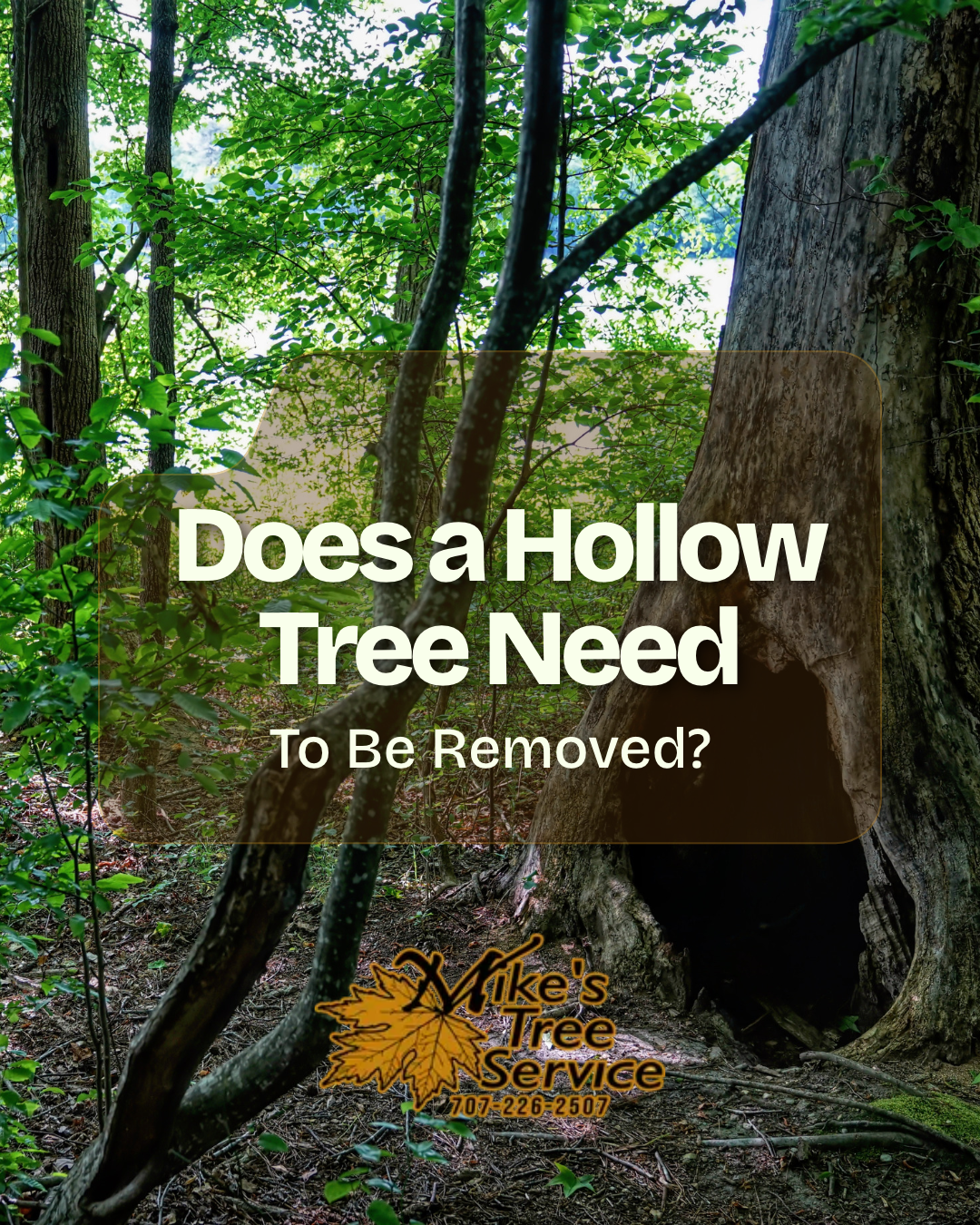
A hollow tree does not automatically need to be removed. Some trees remain alive despite internal decay, but staying alive and being structurally sound are different things. The location of the cavity, condition of the remaining wood, other defects, and what could be struck if the tree fails all matter. A hole beside a quiet, unused area presents a different decision from a weakened trunk beside your front door.
At Mike's Tree Service, we help Napa Valley homeowners work through tree-related concerns without treating every cavity as a removal order. We can discuss your observations, evaluate the proposed tree work, and explain when a more specialized assessment may be appropriate. The aim is to choose a response supported by the tree's condition and its surroundings. Here is what to consider before deciding whether to monitor, prune, or remove a hollow tree.
How Can a Hollow Tree Still Be Alive?
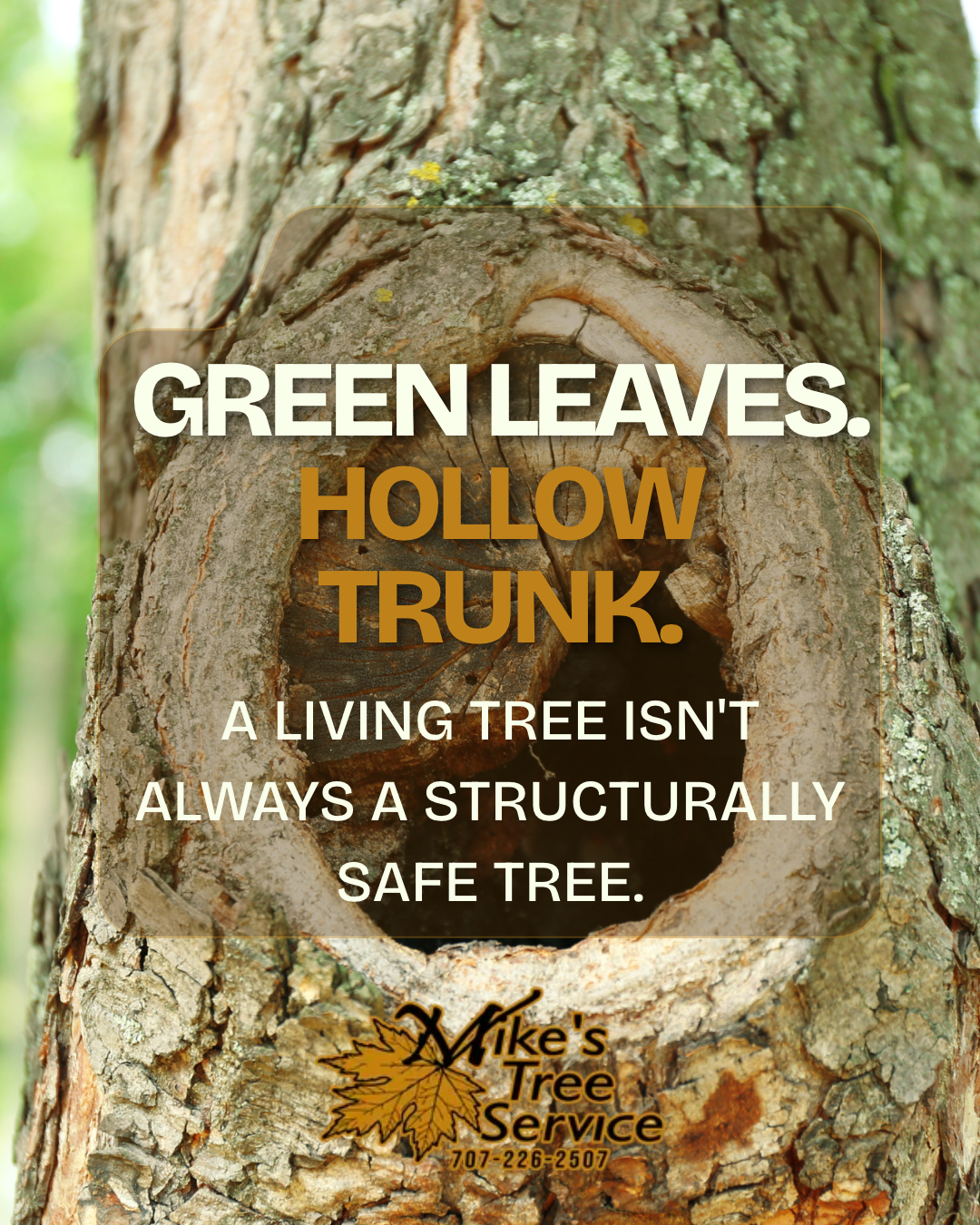
A tree can lose part of its interior wood while living tissues nearer the outside continue supporting growth. That helps explain why a trunk opening can exist beneath a leafy canopy. However, foliage tells you about biological activity, not the full strength of the supporting trunk. You cannot decide whether a hollow tree is dangerous simply by checking whether its leaves are green.
UC IPM's guidance on wood decay fungi in landscape trees explains that decay can reduce wood strength in living trunks and limbs. It also describes why internal deterioration deserves attention even when the whole tree has not died. For a homeowner, the useful question is what the remaining structure can support under the conditions at that site. A professional evaluation brings that structural question together with the people and property around the tree.
What Does a Hole in the Trunk Actually Tell You?
A visible opening tells you there is a feature worth evaluating, but it does not reveal the complete interior. The opening may be narrower than the affected area behind it, or it may look dramatic without establishing imminent failure. Its position on the trunk and relationship to branch attachments are important observations. The sound-looking wood outside the opening also needs to be considered in context.
Take a photograph from a safe location and note when you first noticed the cavity. Tell the person assessing it whether the opening has changed, whether branches have failed, and whether previous work affected that area. Avoid reaching inside or removing material to get a better picture. What seems like a simple inspection by hand can disturb the tree and still fail to answer the structural question.
Which Warning Signs Make a Hollow Tree More Concerning?
A cavity deserves particular attention when other changes appear with it. UC IPM's recognizing hazardous trees guidance lists features such as trunk cracks, fungal growth, dying limbs, and soil fissures among potential warning signs. These observations are prompts for evaluation rather than a reliable homeowner diagnosis. The combination, location, and rate of change matter more than a checklist score.
If a cavity is accompanied by a new crack, changing lean, or movement at the base, keep people away and request prompt help. Do not stand beside the trunk to watch it move during wind or try to test whether a damaged section is firm. Our article about a broken branch still hanging after a storm explains the separate immediate hazard created by suspended limbs. A tree with both trunk concerns and a hanging branch needs a plan that accounts for both conditions.
| Observation | Why it deserves attention | Safe homeowner response |
|---|---|---|
| A cavity with a new or widening crack | More than one structural concern may be present | Keep clear and request prompt evaluation |
| Fungal growth attached to the trunk or base | It may be associated with decay requiring identification | Photograph from a safe distance without disturbing it |
| A newly changing lean or soil movement | The root or supporting system may be involved | Avoid the affected area and report the change |
| Dead, broken, or hanging limbs above the cavity | A branch hazard may exist independently of the trunk | Keep people out from beneath the canopy |
| A longstanding opening with no obvious change | History is useful but does not establish safety | Arrange assessment and discuss an appropriate review plan |
Why the Tree's Location Changes the Decision
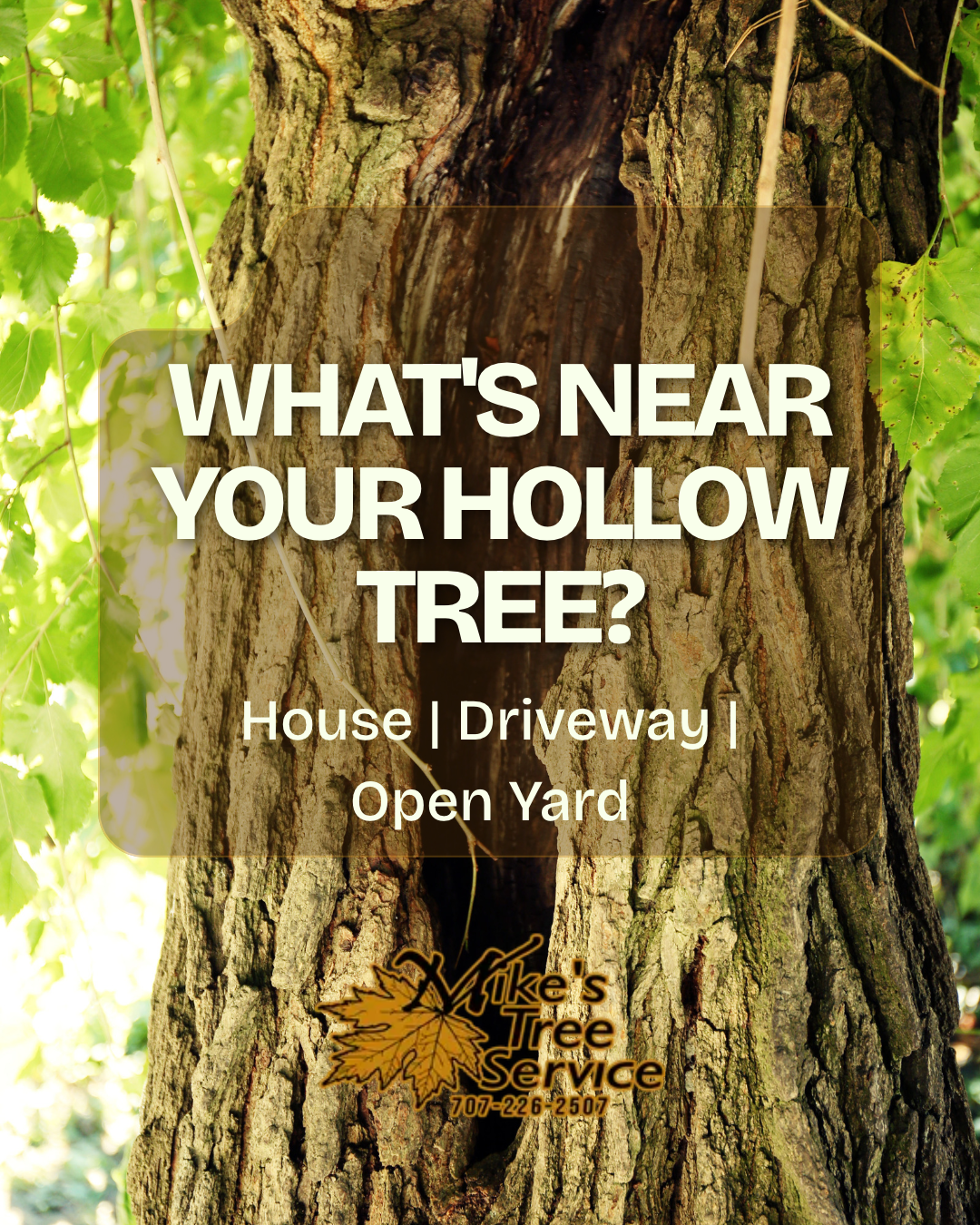
Tree risk involves more than whether a defect exists. A potential failure matters differently when a house, driveway, playground, or frequently used path lies within reach. The way people use the area can also change over time, even if the cavity seems unchanged. Moving a seating area beneath an older tree creates a new reason to review the situation.
For homeowners in Yountville, St. Helena, and Calistoga, the decision should reflect the specific property rather than a general rule about mature trees. Our guide to a tree growing too close to a house explains why distance alone does not settle the question. A hollow trunk near a structure warrants evaluation of both the tree and the consequences of failure. In a low-use area, retaining a tree may be possible when an appropriate assessment supports that choice.
What Should a Professional Assessment Establish?
A useful assessment should explain the observed defects, relevant uncertainties, and what further information may be needed. The evaluator considers the whole tree, its attachments and base, the site, and nearby targets rather than looking only into the hole. Depending on the situation, additional examination by a qualified arborist or specialist may be recommended. A surface view cannot always establish the extent of concealed deterioration.
Be clear about the type of service you are requesting before assuming the visit includes a formal tree risk assessment. A free estimate for pruning or removal is a proposed scope and price for work, while a formal assessment may involve a separately defined inspection and written findings. Ask about the evaluator's qualifications, assessment limits, documentation, and any additional charges. We can discuss your concern and the tree work involved without presenting an estimate as a guarantee of structural safety.
Should You Monitor, Prune, Restrict Access, or Remove It?
Monitoring should follow an assessment rather than replace one. If retention is appropriate, ask what should be checked, when it should be reviewed, and which changes justify an earlier call. Selective pruning may address a specific branch concern when supported by the tree's condition, but it does not rebuild decayed trunk wood. Limiting access can reduce exposure while a decision is being made, provided you can do so without entering the hazard area.
Removal becomes a reasonable recommendation when the assessed risk cannot be reduced adequately through other suitable measures. Our tree removal services address trees where removal is justified by their condition and the work required at the site. The explanation should connect the recommendation to observed conditions rather than simply point to a cavity. Ask what supports retention or removal, and what uncertainties remain before approving the work.
| Option | When it may make sense | What must be clear |
|---|---|---|
| Retain and monitor | An appropriate assessment supports retention under current site use | Review timing, warning signs, and limits of the assessment |
| Selective pruning | Specific branch issues can be addressed without inappropriate cutting | Pruning does not restore missing trunk wood |
| Restrict access | People can safely avoid the potential failure area while arrangements are made | Restrictions must be practical and do not repair the tree |
| Seek further assessment | Concealed decay or conflicting observations leave important questions unresolved | The additional assessment's scope and qualifications |
| Remove the tree | The assessed condition and consequences justify removal over retention | Work method, approvals, access, and cleanup scope |
What Should You Avoid Doing to a Tree Cavity?
Do not fill a hollow trunk with concrete, expanding foam, or other material as a homeowner repair. Filling the visible space does not establish that the tree can safely carry its loads. Penn State Extension's explanation of how decay spreads in trees notes that cavity-filling materials do not provide structural benefit. A filled opening can look repaired without resolving the question that matters.
Also avoid scraping out decayed wood, drilling drainage holes, or cutting away the opening to investigate. Those actions can create additional injuries and complicate a later evaluation. Do not assume a large pruning job will compensate for a hollow trunk, and do not attempt hazardous cutting yourself. Discuss any proposed intervention with an appropriately qualified professional before changing the tree.
How Should You Prepare Before Winter Weather?
Winter preparation begins with arranging evaluation before a worrying tree becomes a storm-time decision. Share recent changes and explain which entrances, parking spaces, or paths are regularly used nearby. If the tree is already showing significant movement or fresh damage, keeping people clear takes priority over gathering more photographs. Wind and wet conditions are reasons to reassess exposure, not proof that every hollow tree will fall.
Homeowners in American Canyon and elsewhere in Napa Valley should also consider whether access arrangements are realistic during poor weather. A plan to avoid the tree is only useful if family members, visitors, and workers know which area to leave unused. Our tree trimming services can address appropriate branch work when that is part of the recommendation. That work should follow the assessment rather than become a general instruction to thin every hollow tree before winter.
What Could Assessment or Removal Cost?
We provide free estimates for proposed tree work, with the scope based on the actual tree and property. For general budgeting, HomeGuide's 2026 tree removal cost guide reports a national average range of 400–1,200, with large or complex jobs reaching about $3,000 in its overview. Those figures describe broad market conditions, not a fixed price for removing a hollow tree. Our estimate accounts for the tree's condition, safe access, nearby structures, equipment needs, and agreed debris handling.
A formal arborist risk assessment should be discussed separately if that is the service you need. Ask what the assessment includes and whether written findings or additional examination are part of the quoted fee. For removal, clarify whether logs, chips, cleanup, and stump grinding are included or priced separately. A lower estimate is not an equivalent option when it excludes work or documentation that another proposal includes.
| Service or budgeting reference | Price information | What to clarify |
|---|---|---|
| Our estimate for proposed tree work | Free | The work being estimated and any assessment limitations |
| General tree removal, national guide | 400–1,200 average range | Broad context rather than our project quote |
| Large or complex removal, national guide | About $3,000 in the guide's overview | A damaged tree or difficult site may require a different scope |
| Formal tree risk assessment | Request a defined scope and fee | Qualifications, methods, written findings, and limitations |
| Stump grinding and additional cleanup | Confirm inclusion or separate pricing | What remains after the tree is removed |
What Should Be Settled Before Work Begins?
Once a recommendation is made, confirm the proposed work and any applicable permissions before the crew begins. The City of Napa's tree guidance describes programs regulating street trees and certain protected or significant trees. Requirements elsewhere in Napa Valley may differ, so the relevant jurisdiction must be checked for the specific property. A visible cavity does not automatically remove the need to confirm applicable rules.
The written scope should also explain access, protection of nearby property, debris handling, and any work that is excluded. Tell the crew about gates, parked vehicles, irrigation, septic components, and other features that could affect access or equipment placement. If the tree is retained, keep the assessment recommendations and arrange the advised follow-up. Whether the outcome is pruning, monitoring, or removal, the decision should leave you with a clear next step rather than a vague reassurance.
Frequently Asked Questions
Is a hollow tree always dangerous?
No. A cavity alone does not establish imminent failure, but it also cannot establish that the tree is safe. Its structure, other defects, and nearby people or property need to be considered through an appropriate assessment.
Can a hollow tree still look healthy?
Yes. Living tissues can continue supporting foliage even when part of the interior has decayed. A green canopy therefore does not settle whether the trunk has sufficient structural strength.
Should I fill the hole in my tree with foam or concrete?
Do not use filling as a DIY structural repair. It does not restore the missing wood's strength or determine whether the tree can be retained. Leave the cavity undisturbed and ask for appropriate professional guidance.
Can pruning save a hollow tree near my house?
Sometimes selective pruning can address a particular branch concern, but it does not repair a decayed trunk. Whether retention is appropriate depends on the whole assessment and the potential consequences of failure. We can discuss suitable tree work and whether further specialist evaluation is needed.
Is a free tree removal estimate the same as a formal risk assessment?
No. An estimate describes proposed work and its price, while a formal risk assessment has a defined evaluation scope and may involve separate fees and written findings. Ask which service is being provided and what conclusions it can support before relying on it for a retention decision.
How can Mike's Tree Service help with a hollow tree?
We can discuss your concerns, evaluate proposed pruning or removal work, and explain when additional assessment may be appropriate. We serve Napa, Yountville, St. Helena, Calistoga, and American Canyon. Contact us with the location and any recent changes, and keep clear of the tree if there are signs of active failure.
Get a Clear Plan for Your Hollow Tree
If you have discovered a hole in a tree trunk, you do not need to decide on removal from appearance alone. We can help you discuss the situation and understand the tree work that may be appropriate. Tell us whether the opening is new, whether other damage is visible, and what lies near the tree. Those details help us understand your concern before the next step is arranged.
Mike's Tree Service works with homeowners throughout Napa Valley on pruning and removal needs. We explain the proposed scope and distinguish an estimate for work from a formal assessment when one is needed. If a tree has a new crack, changing lean, or hanging limb, keep the affected area unused and request prompt help. Contact Mike's Tree Service to discuss your hollow tree and request an estimate for the appropriate work.
Helpful Services and Related Reading