Summer Tree Care in Napa Valley: How to Protect Your Trees From Heat and Drought
Spring pruning and fertilization set your trees up for success — but Napa Valley's dry, hot summers create a second wave of stress that can undo all of that spring work if you're not watching for it. Virtually no rainfall, intense diurnal temperature swings, coastal fog that disappears by mid-morning, and deep soil moisture depletion by late summer combine to create conditions that challenge even well-established trees. Mike's Tree Service has helped Napa Valley homeowners protect their trees through some of the valley's hottest and driest summers on record. This guide covers exactly what to watch for, how to water correctly, and what summer care looks like for Napa's diverse tree population — from native oaks to fruit trees to ornamentals.
Why Napa Valley Summers Are Uniquely Hard on Trees
Napa Valley's growing season is defined by a rare Mediterranean climate — wet winters, dry and warm summers, significant diurnal temperature shifts, and coastal fog that moderates heat in ways most other regions don't experience. The soil here is extraordinarily diverse, containing 33 different soil series and representatives of half the world's soil orders, ranging from volcanic to alluvial fans. Most are well-drained, which forces root systems to dig deeper for water.
This matters for fertilization because water-soluble nutrients like nitrogen, phosphorus, and potassium move through the soil dissolved in water. As Napa's dry season progresses and soil moisture drops, nutrient movement to the root zone slows dramatically — making spring timing critical. Fertilize too early and nutrients wash away with winter rain. Fertilize too late and drought stress makes absorption impossible and potentially harmful.
| Climate Factor | What It Does to Your Trees |
|---|---|
| Dry season aridity | Virtually no rainfall from June through October creates long-term soil moisture deficits that deepen as summer progresses |
| Intense diurnal temperature swings | Dramatic swings between hot sunny days and cool nights stress plant tissue daily — rapid expansion and contraction weakens bark and vascular systems |
| Coastal fog withdrawal | Morning marine layer offers brief relief, but its rapid withdrawal causes a sudden surge in temperature and transpiration — trees can lose significant moisture in hours |
| Deep soil moisture depletion | By late summer, stored winter soil moisture is largely exhausted — trees are running on fumes by August and September |
| Low humidity and high heat | The combination creates semi-arid conditions that accelerate water loss through leaves faster than most root systems can compensate |
Understanding these factors together explains why trees that looked healthy in June can be in serious distress by August — and why proactive summer care matters as much as spring preparation.
Signs Your Trees Are Heat and Drought Stressed
Catching stress early gives you options. By the time a tree shows severe symptoms, recovery is significantly harder and more expensive. Here's what to look for on your Napa Valley property throughout summer:
| Stress Sign | What It Looks Like | What It Means |
|---|---|---|
| Leaf scorch and browning | Brown or brittle edges and tips on leaves | Moisture loss exceeding what the root system can replace |
| Wilting and curling | Leaves drooping during the day and not recovering at night | Severe water deficit — daytime wilting that persists into evening is a serious warning |
| Premature leaf drop | Early yellowing, browning, and shedding before fall | Tree shedding foliage to reduce water demand — a survival response |
| Sparse canopy | Noticeably thinner foliage allowing more light through | Reduced leaf production from nutritional or water stress |
| Bark cracking and cankers | Splits in bark or sunken dead areas on branches and trunk | Sunscald or severe drought stress damaging vascular tissue |
| Twig and branch dieback | Dead brittle twigs at the top or outer edges of the canopy | Top-down dieback indicates the tree is rationing water to its core |
| Chlorosis | Leaves turning light green or yellow prematurely | Nutrient deficiency compounded by water stress limiting absorption |
Napa Valley specifics: Young and recently planted trees are most at risk — their root systems haven't established the depth needed to access deeper soil moisture. Shallow-rooted ornamentals on valley floors and west-facing slopes face the highest summer stress exposure.
How to Water Trees Correctly During a Napa Valley Summer
Watering frequency matters far less than watering correctly. The most common mistake Napa Valley homeowners make is frequent shallow watering — which creates weak surface roots that fail under heat stress. Here's the right approach:
Deep and Infrequent — The Napa Summer Standard
| Approach | What Happens to Roots | Summer Performance |
|---|---|---|
| Frequent shallow watering (lawn sprinklers) | Roots stay near the surface chasing moisture | Weak, heat-vulnerable, unstable in high temperatures |
| Deep infrequent watering (soaker hose, slow trickle) | Roots grow downward seeking moisture | Drought-resistant, stable, better heat tolerance |
How to water correctly:
- Use a soaker hose or hose on a slow trickle for 2 to 3 hours — allowing water to penetrate 12 to 18 inches deep
- Water at the dripline — not at the trunk. The tree's absorbing roots are at the outer edge of the canopy and often extend 10 to 15 feet beyond it
- Place soaker hoses in a circle halfway between the trunk and the dripline, extending outward to the canopy edge
Frequency by tree age:
- Established trees (3+ years) — deep soaking once or twice per month during dry summer months
- Young trees (1–3 years) — 5 to 15 gallons of water 2 to 4 times per week — young root systems can't access deep soil moisture yet
⚠️ Critical: Never Summer Water Native California Oaks This is the most important tree care rule in Napa Valley and the one most frequently broken by well-intentioned homeowners:
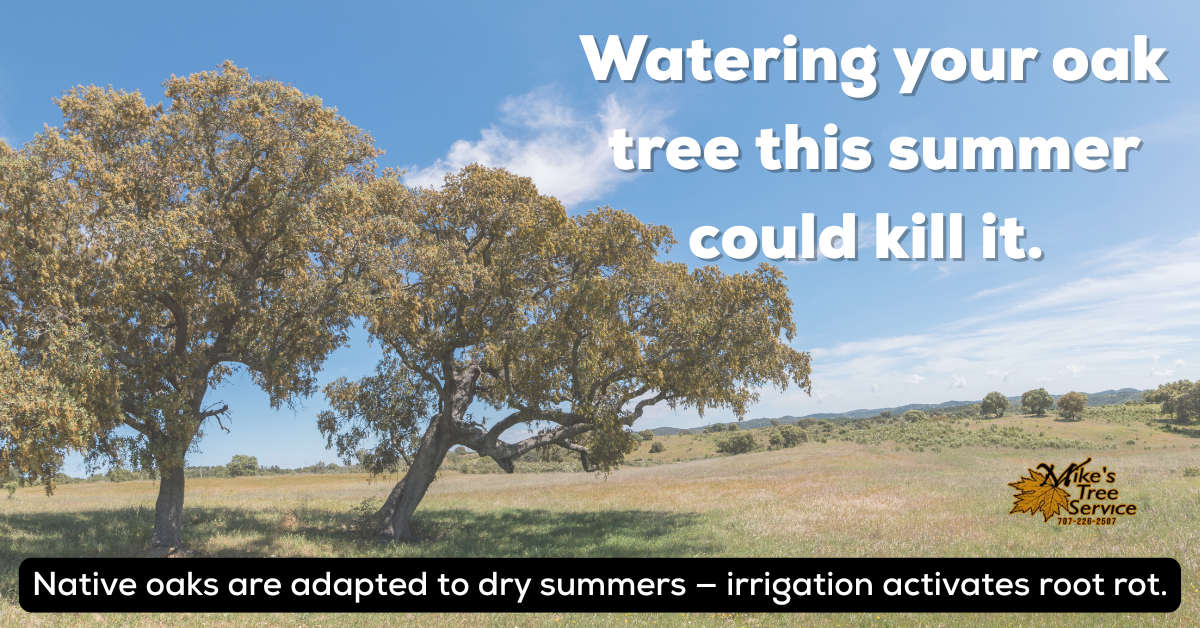
Established California native oaks — Valley Oak, Coast Live Oak, Blue Oak — are adapted to dry summers. Regular summer irrigation activates soil-borne fungi like Armillaria that cause root rot, often killing trees that have stood for decades.
- Keep all irrigation at least 10 feet from the oak trunk at all times
- If an established oak needs emergency water during severe drought, apply water only once every month or two — strictly to the outer two-thirds of the root zone, well away from the root crown
- Never install lawn or garden irrigation under the canopy of a native oak
Mulching: The Single Most Effective Summer Protection Step
If you do one thing for your trees this summer, make it mulching. A properly applied layer of organic mulch reduces soil water evaporation significantly, keeps soil temperatures cooler, and reduces how often you need to water — all critical in a Napa Valley summer.
What mulch does for your trees:
| Benefit | What It Means in Practice |
|---|---|
| Retains soil moisture | Reduces evaporative water loss dramatically — soil stays moist significantly longer between watering |
| Regulates soil temperature | Insulates roots from extreme surface heat — can keep soil measurably cooler on hot days |
| Reduces water demand | Moist, cool soil means trees need less frequent watering — important for water conservation in drought conditions |
| Prevents compaction | Acts as a buffer against rain and foot traffic — prevents surface crusting that blocks water absorption |
How to apply mulch correctly:
- Apply organic mulch — shredded bark or wood chips — at a depth of 2 to 4 inches
- Spread in a wide circle around the tree extending to the dripline or beyond
- The no-contact rule: Keep mulch at least 3 to 6 inches away from the trunk — mulch against the bark causes rot and creates pest habitat
- Water the soil thoroughly before applying mulch if it's already dry
Which Napa Valley Trees Are Most Vulnerable to Summer Stress
Not all trees face equal risk in a Napa summer. Here's how vulnerability breaks down across the species common to Napa Valley properties:
High Vulnerability
- Birch trees — extremely prone to summer stress, aphid infestations, and premature leaf drop in Napa's low humidity
- Liquidambar/Sweetgum — consistently show stress in the valley's dry heat
- Stone fruit trees — apricots, cherries, peaches, plums, and nectarines are sensitive to extreme heat, leading to sunburn, reduced fruit size, and poor fruit set
- Tulip Poplar and Littleleaf Linden — highly susceptible to heat stress in valley conditions
- Young trees of any species — insufficient root depth to access deep soil moisture
Moderate Vulnerability
- Walnuts — moderate heat sensitivity with high water needs
- White Alder and Native Black Walnut — frequently show stress on valley floors
- Blue Oak on west-facing slopes — vulnerable to "hotter drought" conditions that weaken them and increase susceptibility to Mediterranean Oak Borer
Generally Resilient — But Not Invincible
- Established Valley Oak and Coast Live Oak — adapted to dry summers but vulnerable to improper summer watering and weakened by wet springs followed by extreme heat
- Tanoak — watch carefully for Sudden Oak Death, which is triggered by wet springs and accelerates rapidly when summer stress hits
What Summer Heat Does to Trees That Weren't Properly Pruned or Fertilized in Spring
This is where skipping spring care compounds into summer crisis. Trees that didn't receive proper spring pruning and fertilization enter summer already operating at a deficit — and summer heat accelerates every problem:
| Skipped Spring Care | Summer Consequence |
|---|---|
| No pruning | Overly dense canopy forces excessive transpiration — tree sheds leaves or drops branches to reduce water demand. Summer branch drop risk increases significantly |
| No fertilization | Nutritional weakness limits the tree's ability to strengthen cell walls — less capable of resisting heat damage and drought stress |
| No health assessment | Pest and disease vulnerabilities go undetected — weakened trees become prime targets for bark beetles, borers, and fungal pathogens that thrive in summer |
| No mulching in spring | Soil enters summer dry and compacted — moisture retention is poor from the start of the dry season |
Critical summer rule for neglected trees: Do not fertilize a stressed tree in summer — it can scorch already-compromised roots. Focus exclusively on deep-root watering and mulching at the dripline. Call Mike's Tree Service for an assessment if you're seeing two or more stress symptoms — some summer damage is reversible if caught early, and none of it is if left until fall.
How Mike's Tree Service Supports Napa Valley Trees Through Summer
Summer tree care in Napa Valley isn't a single task — it's an ongoing commitment through the valley's most stressful months. Here's how Mike's Tree Service supports Napa Valley homeowners from June through October:
Summer Health Assessments A professional summer health check identifies stress symptoms early — before leaf scorch becomes branch dieback and before bark cracking becomes structural failure. Mike's Tree Service evaluates each tree's species-specific vulnerability, irrigation adequacy, and overall health status — and gives you a clear action plan.
Emergency Limb Removal Summer branch drop is a real and underappreciated risk in Napa Valley — large heavy limbs can fall suddenly without warning as trees shed weight to conserve water. If you notice hanging, cracked, or unusually drooping limbs during summer, don't wait. Emergency limb removal before a branch fails protects your property, your vehicles, and anyone spending time in your yard.
Irrigation Assessment Getting watering right in Napa Valley's summer conditions is harder than it looks — too little and trees decline, too much near native oaks and you trigger root rot. Mike's Tree Service evaluates your current irrigation setup relative to your specific tree species, soil type, and sun exposure — and recommends adjustments that protect trees without wasting water.
Pest and Disease Monitoring Heat-stressed trees are magnets for opportunistic pests and pathogens — bark beetles, borers, Mediterranean Oak Borer, and Sudden Oak Death all accelerate under summer stress conditions. Early identification and treatment saves trees that would otherwise be lost by fall.
Don't let spring's hard work get undone by summer neglect. Contact Mike's Tree Service to schedule your summer tree assessment in Napa Valley before peak heat arrives.
Schedule Your Summer Tree Assessment →
Read: Spring Tree Pruning Tips for Napa Valley →
Read: Tree Fertilization — The Best Month to Start in Napa →