How Soil Quality Is Assessed Before a Land Clearing Project Begins in Northern California
Land clearing in Napa Valley and Sonoma County is not the same as land clearing in most other parts of California. The soil beneath any property in the Glen Ellen, Kenwood, or Napa corridor has a specific profile: texture, drainage characteristics, compaction level, organic matter content, and a relationship with the root systems that have been occupying it for decades or longer. Clear a property without understanding that profile, and the work can create problems the landowner did not have before the project started.
When Mike's Tree Service evaluates a land clearing project in Northern California, the soil assessment is not a separate step from the clearing plan. It is the foundation of it. The approach taken to vegetation removal, the equipment selected, the sequence of the work, and the recommendations made for post-clearing soil management all depend on what the soil can support and what it cannot.
This guide explains what a proper soil quality assessment involves before a Northern California land clearing project begins, why the specific soil conditions of Napa Valley and Sonoma County create considerations that do not exist elsewhere, and what landowners in Glen Ellen, Kenwood, Napa, and the surrounding communities should understand before clearing work starts on their property.
The soil profiles across Napa Valley and Sonoma County are among the most variable and scientifically documented in California, primarily because of the wine industry's longstanding interest in understanding exactly what is beneath any given parcel of land.
According to research from UC Davis and the North Coast Soil Health Hub's Napa Valley vineyard assessment, soil health parameters including aggregate stability, infiltration rates, and compaction levels vary significantly across short distances in this region. A hillside property in Kenwood may sit on Franciscan Complex soils with shallow bedrock and high rock fragment content, while a valley floor property half a mile away has Huichica clay loams with 35 to 50 percent clay content, per Alluvial Soil Lab's Sonoma and Napa soil research. These are not interchangeable conditions. Equipment, technique, and timing all change based on which soil type the clearing project is working in.
The California Residential Land Management Survey 2025 found that 74 percent of California suburban properties show moderate to severe compaction, and 82 percent of new construction sites have suboptimal soil structure. On properties where land clearing is the first step toward building, landscaping, or replanting, failing to understand existing compaction before clearing begins means the project creates conditions that make the post-clearing goals more difficult and more expensive to achieve.
The Four Soil Factors That Shape a Clearing Project
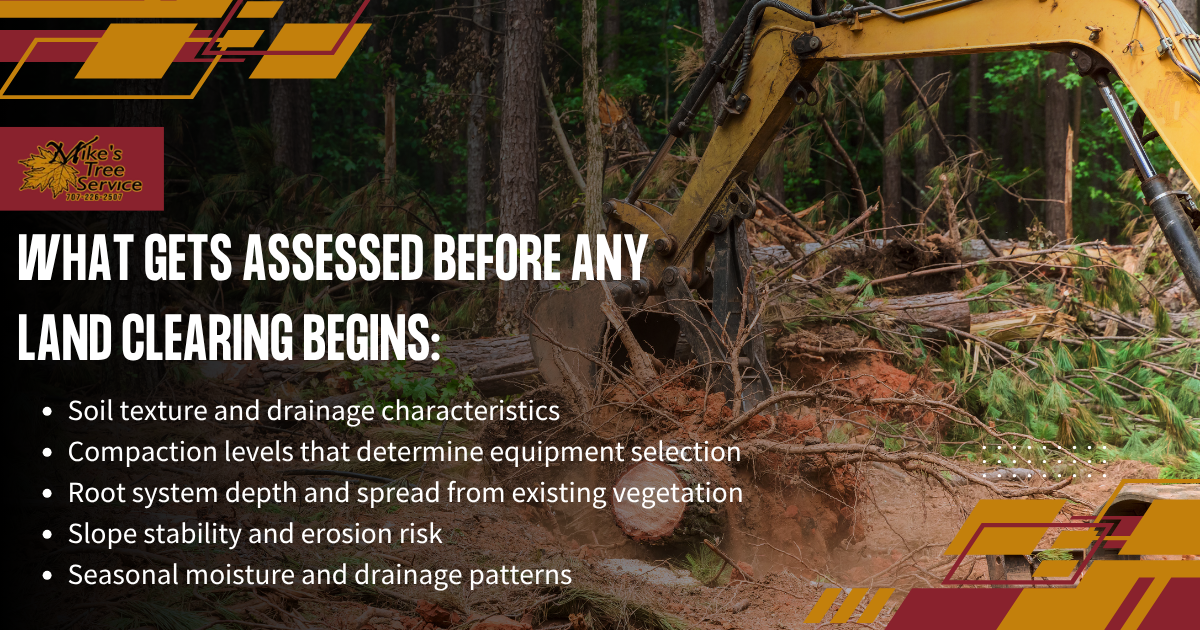
Before any vegetation is removed on a Napa Valley or Sonoma County property, Mike's Tree Service evaluates four soil conditions that directly determine how the project should proceed.
1. Soil Texture and Drainage Characteristics
Soil texture, the proportion of sand, silt, and clay particles, determines how the soil responds to equipment weight, root removal, and post-clearing rainfall. In Sonoma County, the dominant soil types span a wide texture range.
| Soil type | Location | Clay content | Drainage characteristic |
|---|---|---|---|
| Goldridge sandy loam | Russian River Valley and surrounding areas | Low | Excellent drainage, lower compaction risk |
| Huichica clay loam | Carneros and southern Sonoma Valley | 35 to 50 percent | Retains moisture, high compaction risk under equipment |
| Franciscan Complex | Mountainous areas including Kenwood hills | Variable, shallow to bedrock | Poor water infiltration, slope stability concerns |
| Felta gravelly loam | Dry Creek Valley and valley corridors | Low to moderate | Well-drained, good for equipment access |
Clay-heavy soils like Huichica are particularly sensitive to equipment compaction. When heavy machinery works wet clay soil, the clay particles compress into a dense, poorly drained layer that inhibits root development for any replanting that follows. Mike's Tree Service schedules clearing work on clay-heavy Napa Valley and Sonoma County properties during the dry season specifically to reduce this risk.
| Warning sign | What it indicates |
|---|---|
| Sawdust-like frass at the stump base | Active wood-boring beetle or ant activity |
| Small pinholes or galleries in the wood | Established beetle galleries inside the stump |
| Winged insects swarming in spring | Termite or ant colony reproducing from the stump |
| Soft, spongy wood near the base | Advanced decay creating ideal pest habitat |
2. Compaction Level
Existing compaction before a clearing project begins affects both equipment selection and the soil preparation required for any post-clearing use. The California Residential Land Management Survey 2025 found that infiltration rates are reduced by 40 to 60 percent in compacted areas compared to uncompacted soil of the same texture. On a property where the clearing goal is replanting with native vegetation, vineyard development, or landscaping, working heavily compacted soil without addressing it first produces poor establishment outcomes regardless of what is planted.
A basic assessment of existing compaction involves a penetrometer reading at multiple points across the property. This gives a quantitative measure of soil resistance at different depths, identifying where compaction is limiting root penetration and where equipment access during clearing may worsen existing conditions.
3. Root System Depth and Spread
The root systems of the vegetation being cleared are not contained within the visible above-ground footprint of the plant. Valley oaks, coast live oaks, and mature ornamental trees common throughout Napa and Sonoma Valley properties can have root systems that extend 20 to 30 feet or more from the trunk. Stumps from removed trees leave root systems that continue to affect soil structure and moisture distribution for years.
Understanding root depth and spread before clearing begins determines:
- Where equipment can access without causing unnecessary root damage to trees being retained
- What stump treatment is appropriate for preventing disease transmission, particularly Armillaria root rot, which persists in infected root material in the soil
- How the soil moisture pattern on the property will change after major root systems are removed
For properties where Armillaria is a concern in the surrounding tree canopy, the clearing approach for diseased or declining trees directly affects whether the pathogen is managed or spread. For more on this, see Mike's Tree Service's guide to stump grinding and Armillaria management in Napa Valley.
4. Slope Stability and Erosion Risk
Sonoma County's hillside properties, including those in the Kenwood and Glen Ellen corridor, often have slopes where the existing vegetation root system is providing the primary stabilization of the soil. Removing that vegetation without understanding the slope's erosion vulnerability creates risk that increases significantly with the first significant rainfall after clearing.
According to UC Davis Viticulture Program research cited by Alluvial Soil Lab, cover crops can reduce erosion by 60 to 80 percent on sloped vineyard sites. On properties where native vegetation is being cleared on any meaningful slope, the soil assessment should identify erosion risk zones and the clearing approach should account for immediate revegetation or erosion control after work is complete.
What the Assessment Process Looks Like on a Northern California Property
A soil quality assessment before land clearing is not laboratory-intensive for most residential and estate land clearing projects in Napa Valley and Sonoma County. It is a site evaluation that combines visual assessment, basic field testing, and knowledge of the region's documented soil profiles to identify the conditions that will affect the clearing project.
What Mike's Tree Service evaluates before clearing begins:
| Assessment element | What it determines |
|---|---|
| Visual soil texture test | Whether the soil is clay-dominant, sandy, or loamy, and how it will respond to equipment and rainfall |
| Penetrometer compaction reading | Existing compaction level at surface and at depth, identifying risk zones for additional compaction |
| Drainage observation | How quickly water moves through the soil and whether low areas create ponding risk after clearing |
| Root mapping | Where major root systems extend relative to trees being retained and to equipment access paths |
| Slope angle and aspect | Whether erosion risk requires immediate post-clearing stabilization measures |
| Seasonal moisture status | Whether the soil is currently wet enough that equipment access would cause compaction damage |
A stump left in place is not inert. If Armillaria is present, it is an active reservoir. Stump grinding to 6 to 12 inches below grade removes the primary source The 2025 UC Cooperative Extension soil management guide recommends testing soil pH between 6.0 and 7.0 for most intended post-clearing uses, and assessing nutrient levels before applying any amendments. On properties where the landowner plans to replant after clearing, a basic pH test at the assessment stage prevents the common mistake of replanting into soil conditions that are incompatible with the intended species.of fungal spread.
How Soil Assessment Affects Equipment Selection
This is where the soil assessment directly changes what happens on the clearing day. Mike's Tree Service selects equipment based on the soil conditions identified in the pre-project assessment, not based on what is most available or most efficient in isolation.
| Soil condition | Equipment implication |
|---|---|
| Wet clay soil | Clearing deferred until dry season or low ground-pressure equipment used to reduce compaction |
| Shallow bedrock (Franciscan Complex) | Stump grinding depth adjusted to avoid bedrock contact damage |
| Steep slope with erosion risk | Brush removal sequenced to retain ground cover on slopes until erosion control is in place |
| High root density from mature oaks | Hand work or precise mechanical work near retained trees to protect root systems |
| Sandy loam with good drainage | Standard equipment access appropriate, lower compaction risk |
The difference between a clearing project that leaves a property in good condition for its intended post-clearing use and one that creates drainage problems, erosion, and compacted soil that requires remediation before anything can be planted is almost always found in this pre-project soil evaluation.

Seasonal Timing and Sonoma County Soil Conditions
Sonoma County's Mediterranean climate creates a specific seasonal window for land clearing work that soil conditions reinforce. The wet season, roughly November through April, saturates clay-heavy soils to a condition where equipment compaction damage is substantially higher than in dry-season conditions. The dry season, May through October, allows access to the same soils with significantly less compaction risk.
This seasonal consideration is particularly relevant for properties with Huichica clay loam soils in the Carneros and southern Sonoma Valley areas, where the 35 to 50 percent clay content creates high compaction sensitivity when wet. On these properties, scheduling clearing during the dry season is not simply a preference. It is the decision that determines whether the soil condition after clearing supports the landowner's goals or requires remediation before those goals can be pursued.
For properties in the Franciscan Complex hillside soils of the Kenwood area, the slope stability consideration adds a second seasonal dimension: clearing on steeper slopes before the wet season is complete means the cleared surface is exposed to the highest rainfall period without established ground cover. Mike's Tree Service discusses timing considerations explicitly during the assessment phase so the project schedule accounts for both soil access conditions and post-clearing erosion risk.
Should Your Property Have a Soil Assessment Before Clearing?
| Property characteristic | Assessment priority |
|---|---|
| Clay-heavy valley floor soils | High. Compaction risk during clearing is significant |
| Hillside property with any slope | High. Erosion risk after clearing requires pre-project assessment |
| Property near established oaks or ornamentals | High. Root mapping protects retained trees |
| Existing declining or diseased trees | High. Armillaria management requires informed approach |
| Sandy loam valley floor, dry season clearing | Moderate. Lower compaction risk but drainage and replanting goals still benefit from assessment |
| Flat property, simple brush clearing, no replanting planned | Lower. Standard assessment during project walkthrough is typically sufficient |
Frequently Asked Questions
For stumps on properties with established native oaks or vineyard plantings where Armillaria or other disease transmission is a specific concern, Mike's Tree Service can include a tree health assessment of the surrounding trees as part of the stump grinding visit.
Does Mike's Tree Service perform soil assessments before every clearing project?
Yes. Every land clearing project in Napa Valley and Sonoma County begins with a property walkthrough that evaluates the soil conditions, slope, drainage, root systems, and access considerations that affect the clearing approach. This is part of every project, not a separate service.
How does the soil assessment affect the clearing cost?
The assessment itself is included in the project evaluation. The findings may affect approach, timing, and equipment selection, which can influence project scope. In most cases, the assessment identifies conditions that prevent more expensive post-clearing remediation, making the net result cost-effective for the landowner.
Can land clearing happen in the rainy season on Napa Valley properties?
On some soil types and for some project scopes, yes. On clay-heavy soils during wet conditions, the compaction risk is high enough that Mike's Tree Service recommends deferring to the dry season or using specialized low-ground-pressure equipment. This is determined during the assessment.
What happens to the soil after clearing?
The wood chips and mulch produced during clearing can be left in place to decompose and return organic matter to the soil, which directly benefits the soil health parameters UC Davis Cooperative Extension identifies as critical for replanting success. On steeper slopes, chips can be spread as erosion control material immediately after clearing.
How does clearing affect the remaining trees on the property?
Removing significant vegetation changes the soil moisture dynamics across the entire property. Trees that were adapted to competing with the cleared vegetation for moisture will experience a temporary increase in available water. On properties with mature native oaks, this change is generally beneficial. The root mapping done during the assessment ensures that equipment access during clearing does not damage root systems of trees being retained.
If you're planning a land clearing project on a Napa Valley or Sonoma County property, Mike's Tree Service can evaluate your property and help you determine the approach that protects your soil, your retained trees, and your long-term land management goals.